 Zoho CRM
Zoho CRM review 2026: our full test, pricing and limits
Zoho CRM is the quiet champion of features per dollar. Where rivals reserve workflows, forecasting and dashboards for their upper tiers, the Indian vendor ships them from fourteen dollars a seat, throws in a free plan for three people and adds its own artificial intelligence assistant. The trade-off shows up on your first login: a dense interface that asks for patience. We tested it to see whether the bargain holds.
Verdict: the best features-per-dollar ratio on the market
No competitor packs this many advanced features at this price. Workflows, sales forecasting, custom dashboards and the Zia AI assistant are all there from the Standard edition, and an ecosystem of more than fifty in-house apps covers accounting, support and email marketing without leaving the family. The price you pay is not financial but ergonomic: the interface is dense and onboarding takes real time.
What to remember
- A free plan that is genuinely usable for up to three users.
- Four editions from $14 to $52 per user per month, workflows included in the first.
- A dense interface: expect two to three weeks before the team is comfortable.
What we liked
- +
The best features-per-dollar ratio in our comparison: workflows and forecasting from $14.
- +
A credible free plan for three users, with no time limit.
- +
More than fifty in-house Zoho apps, from accounting to help desk.
- +
The Zia AI assistant is included, for lead scoring and next-action suggestions.
- +
Choice of hosting region, including US and EU data centers.
What could be better
- –
A dense, option-heavy interface with a real learning curve.
- –
A small team without a technical lead can drown in configuration.
- –
Standard support answers more slowly than the big American vendors.
- –
Usage limits such as API call volume differ by edition and surface late.
Spec sheet
- Free plan
- Yes, up to 3 users
- Entry edition
- Standard, $14/user/month
- Top edition
- Ultimate, $52/user/month
- Full suite
- Zoho CRM Plus, around $57/user/month
- Hosting regions
- US, EU, India, Australia
- In-house apps
- 55+
- Artificial intelligence
- Zia, included
- Mobile apps
- iOS and Android
- Best for
- A growing SMB that wants everything in one house
List prices per user per month on annual billing, taxes excluded, checked on 3 August 2026. Monthly billing runs roughly 20 to 34 % higher. Verify the current grid before you commit.
Go for it if
- ✓
You want the most features for a tight budget and will invest the time to learn them.
- ✓
Your company is growing and you would rather one vendor covered accounting, support and email too.
- ✓
You care about choosing which region stores your data.
Look elsewhere if
- ✕
You want a tool that works by the end of the afternoon, with no setup.
- ✕
Nobody on the team has time to learn a dense interface.
- ✕
All you actually need is a simple visual pipeline.
What exactly is Zoho CRM?
Zoho is an Indian software company founded in 1996 and based near Chennai, which has spent thirty years building an unusually broad suite: more than fifty business applications, from accounting to video conferencing, all designed to work together. Zoho CRM is its flagship, used by hundreds of thousands of companies worldwide.
What makes the vendor unusual is its business model. Zoho has never raised outside funding and does not chase growth at any cost, which lets it price well below the American majors at comparable feature levels. In practice, what Salesforce or HubSpot bill at their middle tier, Zoho often ships in its entry edition.
The CRM itself centralises contacts, accounts, deals and activities, with the full toolkit: territory management, lead scoring, forecasting, partner portals. More importantly, it talks natively to the rest of the house, Zoho Books for invoicing, Zoho Desk for support, Zoho Campaigns for email. That is where its real advantage over a standalone CRM lies.
What are the key features of Zoho CRM?
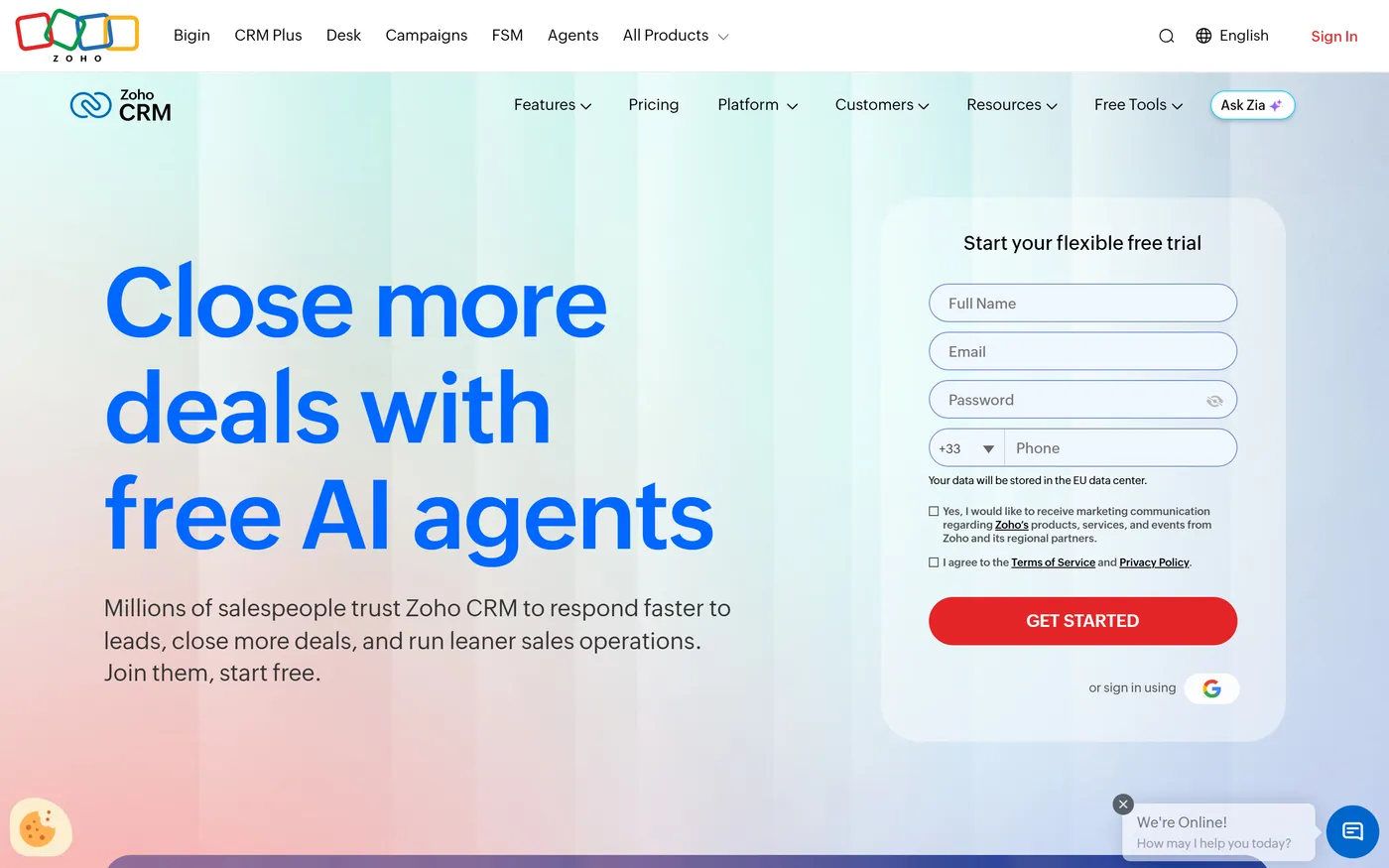
The free plan already covers the essentials for three users: leads, contacts, accounts, deals, tasks and mobile apps. That is enough for a young company to stop running its pipeline in a spreadsheet, which remains the real competitor of every CRM on this list.
The Standard edition opens what the product is known for: workflow rules that fire an action when a condition is met, sales forecasting, custom dashboards and lead scoring. On that specific point, getting those three blocks for fourteen dollars is a market anomaly, since most competitors reserve them for tiers two to four times more expensive.
Above that, Professional adds stage-by-stage sales process management and inventory features, while Enterprise brings advanced multi-currency, territories and deep customisation. The Zia assistant, Zoho’s own AI, flags anomalies in your activity, predicts conversion likelihood and suggests the best moment to call a prospect back.
Zoho CRM is not judged on any single feature but on what it saves you from buying elsewhere: invoicing, support, email marketing and CRM from one vendor, on one database.
Try Zoho CRM for free
The free plan takes three users with no time limit, enough to judge the interface on your own data.
How much does Zoho CRM cost? Editions and pricing
Zoho runs an honest freemium model followed by four paid editions, billed per user per month. The free plan caps at three users, but it does not expire and asks for no credit card.
| Edition | Annual billing | Monthly billing | What it adds |
|---|---|---|---|
| Free | $0 | $0 | 3 users, leads, contacts, deals, mobile |
| Standard | $14/user/mo | $20/user/mo | Workflows, forecasting, dashboards, scoring |
| Professional | $23/user/mo | $35/user/mo | Sales processes, email integration, inventory |
| Enterprise | $40/user/mo | higher | Territories, deep customisation, full Zia |
| Ultimate | $52/user/mo | higher | Advanced analytics, raised usage limits |
List prices per user per month, taxes excluded, checked on 3 August 2026. Monthly billing runs roughly 20 to 34 % higher than annual. The Zoho CRM Plus suite, which bundles nine sales, marketing and support apps, sits around $57 per user per month.
For a five-person SMB the arithmetic is quick: about $70 a month on Standard, against more than double at most competitors for a comparable feature set. Add invoicing and customer support and the CRM Plus suite still costs less than stitching three separate subscriptions together.
One caveat deserves attention: several usage limits, such as API calls, workflow rules and record counts, depend on the edition. They rarely trouble a classic SMB, but a company that automates heavily should check them before committing, or risk moving up a tier for a purely technical reason.
Who is Zoho CRM for?
Zoho CRM is aimed first at growing small and mid-sized businesses that want enterprise-grade features without the enterprise invoice, and accept spending a few weeks learning the tool. It is also a rational pick for companies that would rather have one vendor for CRM, invoicing and support than a patchwork of tools held together by connectors.
It suits teams chasing immediate simplicity far less well. A two-person company with no technical lead will often feel buried in options and will be more comfortable with Pipedrive, whose visual logic clicks in an afternoon. Likewise, if inbound marketing is your priority, HubSpot CRM remains more polished on that specific ground.
What are the alternatives to Zoho CRM?
Depending on what holds you back, three routes. Pipedrive if Zoho’s dense interface puts you off: you lose functional depth, you gain immediate clarity. HubSpot CRM if marketing weighs as much as sales in your growth, with a more generous free plan on contacts. Salesforce if you expect to outgrow any SMB tool within two years and want the deepest platform available.
To arbitrate on total cost rather than sticker price, read our comparison of the best CRM software in 2026, and our guide to choosing a CRM if your criteria are not settled yet.
Our verdict: 4.4/5, the best value in the category
Start on the free three-user plan, two weeks will tell you whether the interface suits your team.
Frequently asked questions
Is Zoho CRM really free?
Yes, for up to three users and with no time limit. The free plan covers leads, contacts, accounts, deals and the mobile apps. Workflows, forecasting and custom dashboards require the Standard edition, at $14 per user per month on annual billing, checked in August 2026.
Why is Zoho CRM cheaper than its competitors?
Zoho is an independent vendor that has never raised outside funding and builds its fifty-plus applications in house, with a cost structure far below the listed American majors. It passes part of that saving to customers, which is why its Standard edition includes features rivals reserve for tiers two to four times more expensive.
Where is Zoho CRM data hosted?
Zoho lets you pick the hosting region when you create the account, including data centers in the United States and the European Union. The choice matters for GDPR and for customer contracts that specify data location, and changing region afterwards is not trivial, so decide at signup.
Zoho CRM or HubSpot: which should you choose?
Zoho CRM wins on features per dollar and on covering a growing SMB end to end. HubSpot stays ahead on ergonomics, on free plan contact limits and on marketing automation. If budget is the deciding factor and you accept a longer ramp-up, Zoho is the rational choice.