Which is the best ERP for a small business in 2026?
An ERP (Enterprise Resource Planning) system pulls finance, purchasing, sales, inventory, production and sometimes payroll into a single shared database. For a small business, the best ERP is not the richest one, it is the one whose real cost, deployment model and support fit your size. We compared the leading ERP platforms available to English-speaking small and mid-sized businesses. Here is our 2026 shortlist, ranked on real cost, cloud deployment, modularity and room to scale. For a broader ranking across every company profile, see our complete guide to the best ERP software in 2026.

Our picks at a glance
Our pickOdoo, the modular open-source ERP with the best coverage-to-price ratio, transparent public pricing and a free plan to start on a single app.
See ↓ Most affordableERPNext, the open-source ERP that is free to self-host with no per-user licensing, ideal for micro and small businesses on a tight budget.
See ↓ Best for Microsoft usersDynamics 365 Business Central, Microsoft’s cloud ERP, native with Microsoft 365 and built to grow from small business to mid-market.
See ↓ Most scalableOracle NetSuite, the cloud ERP mid-market benchmark, with deep multi-entity and audit-ready finance for fast-growing companies.
See ↓ Most flexible pricingAcumatica, a 100% cloud ERP that bills on consumption rather than per user, so extra staff never inflate your licence bill.
See ↓At a glance
The best small business ERP systems compared
| ERP | Score | Deployment | Open source | Best for | From | |
|---|---|---|---|---|---|---|
| Odoo Our pick | ★★★★½ 4.5 | Cloud or on-premise | ✓ | Modular growth | Free* | See → |
| ERPNext Affordable | ★★★★☆ 4.2 | Cloud or self-hosted | ✓ | Tight budgets | Free | See → |
| Dynamics 365 Business Central | ★★★★½ 4.4 | Cloud (SaaS) | ✗ | Microsoft 365 shops | $80 | See → |
| Oracle NetSuite | ★★★★½ 4.4 | Cloud (SaaS) | ✗ | Fast-growing firms | Custom | See → |
| Acumatica | ★★★★☆ 4.2 | Cloud (SaaS) | ✗ | Growing teams | Custom | See → |
Indicative prices recorded in July 2026. *Odoo offers a free One App Free plan (a single app, unlimited users), then $24.90/user/month on the Standard plan and $37.40/user/month on Custom (annual billing, list price, source odoo.com/pricing; Odoo’s price varies significantly by country). ERPNext is free to self-host (hosting and implementation costs apply); managed Frappe Cloud hosting starts around $5/month and bills on compute usage, not per user. Dynamics 365 Business Central lists at $80/user/month (Essentials) and $110/user/month (Premium), Microsoft public pricing in effect since November 2025, usually contracted through a partner. NetSuite and Acumatica are sold on custom pricing through the vendor and its partners; NetSuite typically runs from a ~$999/month base plus per-user fees.
Want to start without paying for a licence?
Odoo’s free One App Free plan (one app, unlimited users) lets you test the modular approach before you commit to anything.
The shortlist in detail
Our top 5 ERPs for small businesses, analysed

Odoo
The modular ERP with the best coverage-to-price ratio
- +
Modular by design: switch on accounting, sales, inventory, manufacturing (MRP), purchasing or HR as your business grows, and pay only for what you use.
- +
Transparent public pricing, still rare in this market: Standard at $24.90/user/month and Custom at $37.40 (annual, list price, indicative July 2026).
- +
Huge global partner network and active community, with an open-source core (the free Community edition) and a free One App Free tier.
- –
The real bill climbs with paid third-party apps from the Odoo App Store and, above all, the cost of implementation and setup by a partner.
- –
The free Community edition is far more limited than Enterprise (no full accounting, no official mobile app).
Our verdict
Odoo takes our top spot for most small businesses: a modular approach where you enable app after app (accounting, sales, inventory, manufacturing, e-commerce), transparent public pricing that is rare in this market, and a One App Free tier to start with no licence. The real caveat is the cost of a serious deployment, which almost always goes through an integrator.

ERPNext
The best pick for a tight budget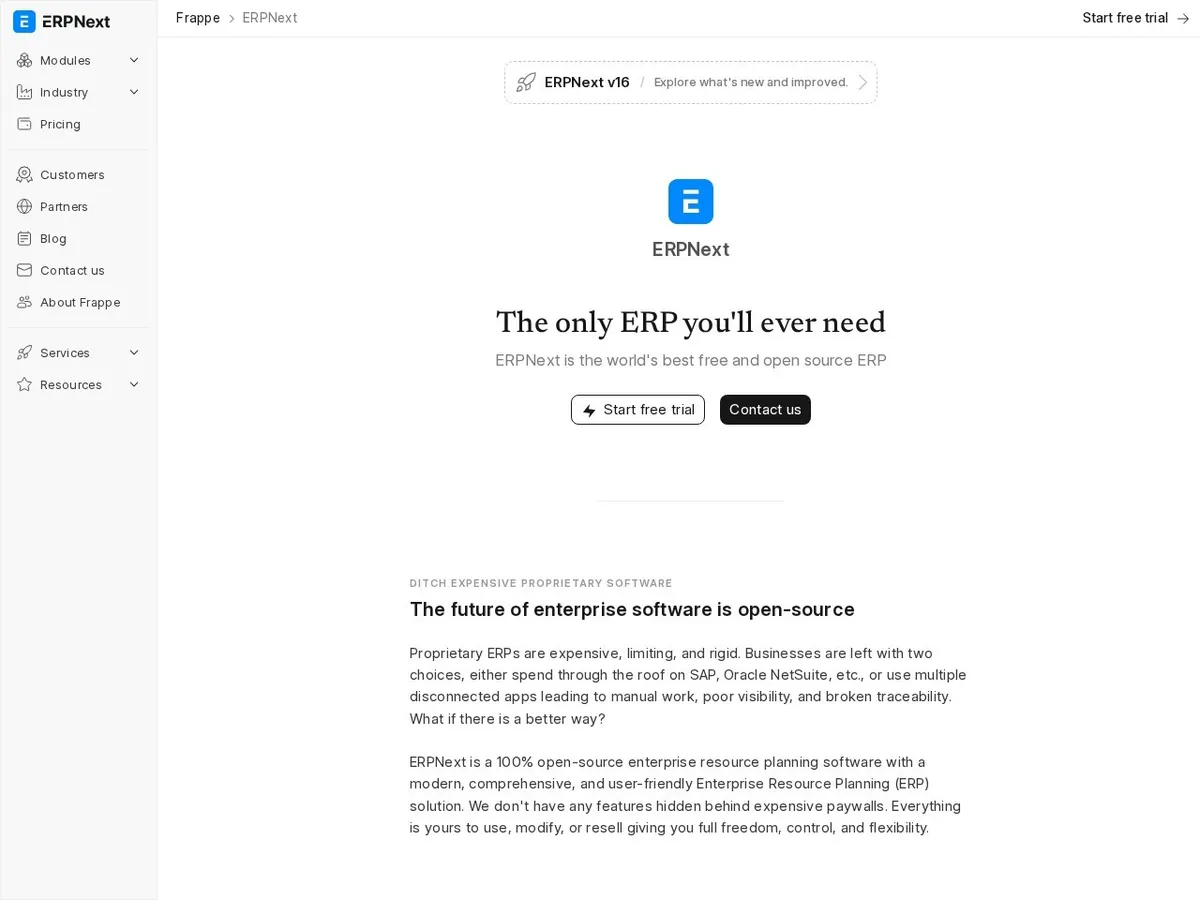
- +
Genuinely free open-source software when self-hosted: accounting, invoicing, inventory, buying, selling, manufacturing and a light CRM, with no licence to pay.
- +
Managed Frappe Cloud hosting starts around $5/month and bills on compute usage, not headcount, so adding staff does not raise your subscription (indicative July 2026).
- +
Surprisingly complete for a free ERP, and well suited to a micro or small trading or services business.
- –
The interface is plainer and less polished than the big proprietary cloud suites in this comparison.
- –
Self-hosting demands real technical skills; without an in-house admin you will need a paid implementation partner.
Our verdict
ERPNext is our most affordable pick: genuinely licence-free when self-hosted, it covers ERP and a light CRM and fits a micro or small business well. In exchange you accept an interface less polished than modern proprietary suites, and a real cost that shifts to hosting, maintenance and integration.
No time to read it all?
For most small businesses, Odoo remains the best balance of versatility, modularity and transparent public pricing.

Dynamics 365 Business Central
The best pick to grow from small business to mid-market
- +
Native integration with Microsoft 365, Teams and the Power Platform: a real advantage if your business already lives in the Microsoft ecosystem.
- +
Continuous SaaS updates, built-in BI and Copilot AI, and broad support for e-invoicing standards.
- +
Solid functional coverage (finance, sales, purchasing, inventory, projects) that carries you from small business to mid-market.
- –
High per-user cost: $80/month (Essentials) and $110/month (Premium), Microsoft public pricing since November 2025.
- –
Rarely deployed solo: it almost always goes through a partner, with implementation quoted separately. There is also no on-premise option in this SaaS edition.
Our verdict
Business Central shines the moment your small business already lives in Microsoft 365: native integration with Excel, Teams and Outlook, a full cloud ERP on Azure and the Copilot assistant. The licence price is public (from $80/user/month), but deployment runs through a Microsoft partner whose cost is not advertised.

Oracle NetSuite
The cloud ERP benchmark for fast-growing companies
- +
The mid-market cloud ERP benchmark: deep, audit-ready financials that handle multi-entity, multi-currency and consolidation out of the box.
- +
One unified suite (finance, CRM, inventory, order management, e-commerce) that keeps pace as a small business scales up fast.
- +
Mature platform with a vast partner ecosystem and a proven upgrade path to enterprise scale.
- –
The most expensive option here: a typical small deployment runs roughly $12,000 to $60,000/year (base plus per-user fees), before implementation.
- –
No public price list and everything negotiated, which makes budgeting hard and can be overkill for a very small team.
Our verdict
NetSuite is the pick for a small business that intends to scale fast: audit-ready, multi-entity, multi-currency finance in a single cloud suite, with a proven path to enterprise size. The trade-off is cost and opacity, no public price, negotiated contracts and a footprint that can be oversized for a very small team.

Acumatica
The best cloud ERP for teams that keep hiring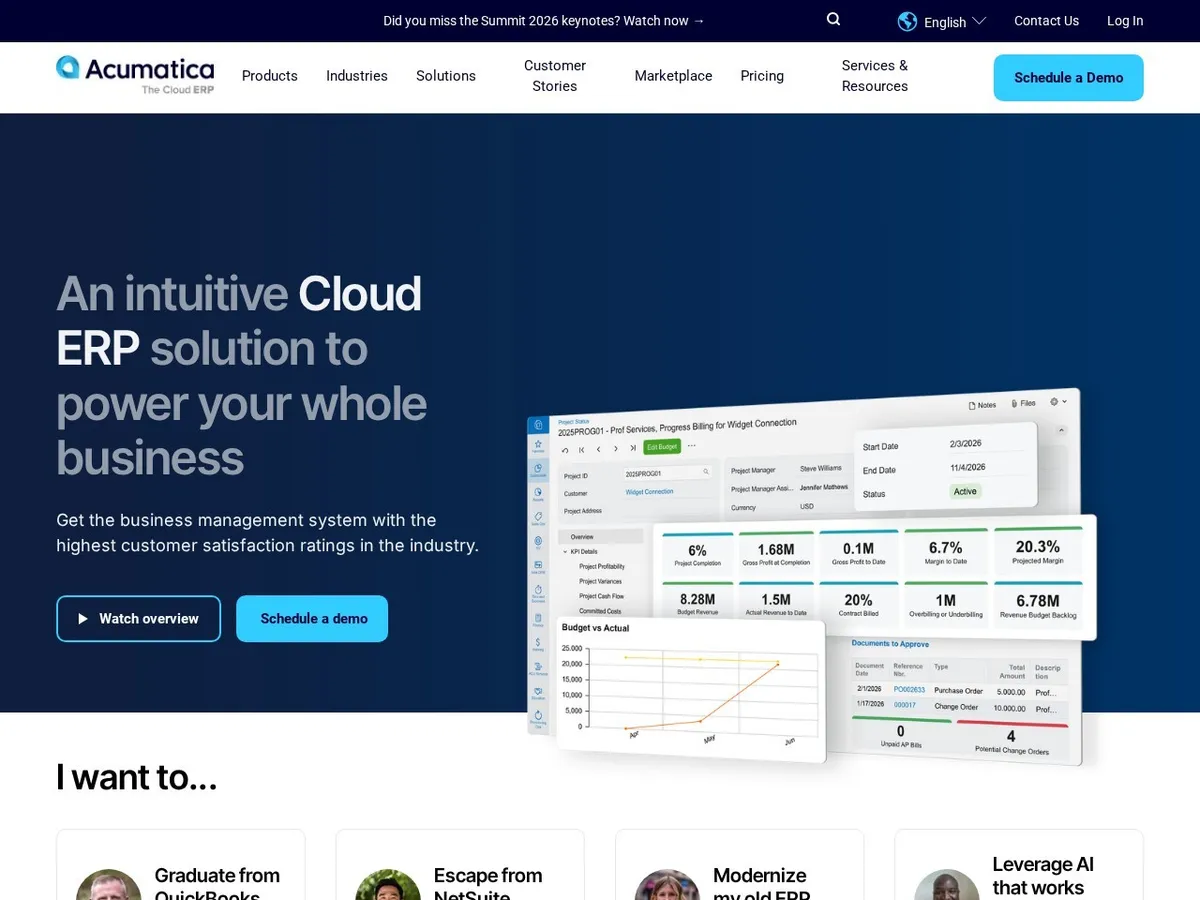
- +
Consumption-based pricing with no per-user licence: you pay for the resources you use, so growing your headcount never inflates the bill.
- +
Modern, fully cloud architecture with strong industry editions (distribution, manufacturing, construction, retail).
- +
Consistently high customer satisfaction and a flexible, extensible platform for growing small and mid-sized businesses.
- –
Custom pricing only: you need a partner quote, which makes upfront budget comparison harder.
- –
Best suited to already-structured SMBs; likely oversized for a micro business of a few people.
Our verdict
Acumatica is the smart pick when your team keeps growing: consumption-based pricing means adding staff never inflates the licence, a rare model in the ERP world. The counterpart is opacity, pricing is quoted only through a partner, and the platform is best for an already-structured small business rather than a handful of people.
Ready to scope your ERP project?
Odoo covers the vast majority of small business needs with no entry budget, and grows module by module alongside you.
Our analysis
Comparison: real cost, deployment and room to grow
For a small business, an ERP is decided on three battlegrounds: what it truly costs once implementation is counted, how it is deployed (cloud SaaS, self-hosted, per-user or consumption pricing) and how well it grows with you without a painful migration. Here is our comparative read, to weight against your size and industry.
Our method. Scores are built from vendor documentation, public pricing grids (July 2026), verified G2 and Capterra reviews and our hands-on testing. Each criterion is weighted by how much it matters to a small business, where budget and setup effort weigh heaviest.
Real cost for a small business
Sticker price is only half the story. What matters is the total cost of ownership: licence, but also implementation, data migration and training, which on an ERP often cost as much as the software itself. Our score rewards a low, predictable entry cost, the reality most small businesses live with.
Affordability for a small business · score out of 10
The longer the bar, the lower and more predictable the real cost to get started.
ERPNextOdooAcumaticaBusiness CentralOracle NetSuite- ERPNext and Odoo let you start at or near zero: self-hosting or the One App Free tier keep the entry cost minimal.
- Acumatica avoids per-user fees with consumption pricing, a plus for teams that hire, but still needs a partner quote.
- NetSuite is the priciest here, with a base licence around $999/month plus per-user fees before implementation.
Key takeaway. Always budget the implementation, not just the licence. A free ERP with a $10,000 setup can cost more year one than a paid SaaS with a light roll-out.
Deployment and pricing model
The deployment model drives your IT load, your data residency and how your bill behaves as you grow. Cloud SaaS spares you a server; self-hosting cuts the licence but needs skills; per-user versus consumption pricing changes everything once you start hiring.
✓ available · ✗ not available. Scroll the table if needed.
| ERP | Cloud SaaS | Self-hosted | Open source | Pricing model | Mobile app |
|---|---|---|---|---|---|
| Odoo | ✓ | ✓ | ✓ | Per user (free tier) | ✓ |
| ERPNext | Frappe Cloud | ✓ | ✓ | Compute usage | ✓ |
| Business Central | ✓ | ✗ | ✗ | Per user | ✓ |
| Oracle NetSuite | ✓ | ✗ | ✗ | Base + per user | ✓ |
| Acumatica | ✓ | Private cloud | ✗ | Consumption | ✓ |
- Cloud-only: Business Central and NetSuite run as pure SaaS, a plus if you never want to manage a server.
- Self-hostable: Odoo and ERPNext can still be installed on your own infrastructure to contain the licence.
- Pricing model: ERPNext (compute) and Acumatica (consumption) do not charge per user, unlike Odoo, Business Central and NetSuite.
Key takeaway. If your team is set to grow fast, a consumption or compute model (Acumatica, ERPNext) keeps costs flatter than per-user pricing. If you want zero servers, stick to a pure SaaS.
Room to grow and scalability
An ERP commits a small business for years: it must absorb growth (users, sites, volumes, subsidiaries) and carry you from small business to mid-market without a costly re-platforming.
Ability to grow (users, sites, international) · score out of 10
The longer the bar, the better the platform carries you toward mid-market.
Oracle NetSuiteBusiness CentralAcumaticaOdooERPNext- NetSuite and Business Central absorb heavy growth and multi-entity, multi-country setups best.
- Acumatica and Odoo scale well for a growing SMB, with Odoo customising very finely but needing skills.
- ERPNext plateaus sooner: perfect for a small business, less so for a multi-site enterprise.
Key takeaway. Choose the ERP for your 3-to-5-year trajectory, not just today’s size. Migrating ERPs is expensive; better a foundation that follows your growth.
Which ERP for which small business?
In short, here is our recommendation by profile and situation:
| Your profile | Our pick | Why |
|---|---|---|
| Micro business on a budget | ERPNext | Free to self-host, no per-user fee, covers the ERP essentials |
| Growing small business | Odoo | Modular, transparent pricing, start free and add apps as you grow |
| Microsoft 365 shop | Business Central | Native with Teams, Outlook and the Power Platform |
| Fast-scaling company | Oracle NetSuite | Multi-entity, audit-ready finance and a path to enterprise scale |
| Team that keeps hiring | Acumatica | Consumption pricing, so more staff never inflates the licence |
| Manufacturer / distributor | Odoo · Acumatica | Strong MRP and inventory with industry editions |
Key takeaway. For most small businesses, Odoo remains the best starting point. Reserve NetSuite for companies about to scale fast, and pick ERPNext when budget is the hard constraint.

How did we build this ranking?
Each ERP is scored on four weighted axes, framed for the reality of a small business: real cost (licence and per-user price, but also implementation and setup, often the true budget line), deployment (cloud SaaS, self-hosted or on-premise, and how easy it is to get running), modularity (the ability to switch on only the functions you need and then scale: accounting, sales, purchasing, inventory, manufacturing, HR) and room to grow (how well the platform carries you from small business to mid-market). We favour tools genuinely sized for small businesses, and we re-check every pricing table whenever it changes, which is why the update date sits at the top of the page. Ratings are editorial and reflect our comparative analysis, not an aggregated customer score.
How do you choose the right ERP for a small business?
Start with functional scope: a services or trading business usually needs only accounting, sales, purchasing and inventory, whereas a manufacturer needs a real production module (MRP). There is no point paying for modules you will never switch on. Next check the deployment model: cloud SaaS (Business Central, NetSuite, Acumatica, Odoo Online) cuts your internal IT load and spreads cost over a subscription, while self-hosting (ERPNext, Odoo Community) minimises the licence but demands technical skills.
Weigh the total cost of ownership, not just the sticker price: on an ERP, implementation, data migration and training often cost as much as the licence, especially on custom-priced systems like NetSuite or Acumatica. Finally, secure the support: a nearby implementation partner is the difference between a smooth roll-out and a stalled project. To go deeper and widen the field to every ERP profile, read our complete guide to the best ERP software in 2026 and our ERP hub.
Which ERP fits your profile?
For a micro business or a tight budget, ERPNext when self-hosted or Odoo’s One App Free tier let you start without a heavy licence. For a growing small business that wants a scalable foundation and a readable price, Odoo is our default recommendation. A company already invested in Microsoft will benefit from evaluating Dynamics 365 Business Central. A fast-scaling business with multiple entities and currencies will find its match in Oracle NetSuite, while a team that keeps hiring will appreciate Acumatica’s consumption pricing. New to the category? Start with our explainer on what an ERP is.
Frequently asked questions
What is the best ERP for a small business in 2026?
For most small businesses, Odoo offers the best balance of modularity, transparent public pricing (from $24.90/user/month billed annually, indicative July 2026) and a large partner network. A business on a tight budget should look at ERPNext, which is free to self-host with no per-user fee. A company already using Microsoft 365 will get the most from Dynamics 365 Business Central, a fast-growing firm that needs multi-entity, audit-ready finance should consider Oracle NetSuite, and a team that keeps hiring will like Acumatica’s consumption pricing.
Odoo or ERPNext: which open-source ERP should you choose?
Both are open source but aim at different needs. ERPNext is completely free to self-host and bills on compute usage rather than per user, which makes it the cheapest route for a micro or small business. Odoo is richer and more modular (up to manufacturing and HR), with a polished Enterprise edition at $24.90/user/month (annual, list price, indicative July 2026) and a much larger partner ecosystem, better suited to a business that wants to scale.
How much does an ERP cost for a small business?
It ranges from free (ERPNext self-hosted, Odoo’s One App Free plan) to tens of dollars per user per month for cloud ERPs like Odoo ($24.90) or Business Central ($80 Essentials, Microsoft list price). NetSuite and Acumatica are sold on custom pricing, with NetSuite typically starting near a $999/month base plus per-user fees. Beyond the licence, implementation, data migration and training often make up a large part of the total budget.
Cloud or on-premise ERP: which is better for a small business?
Cloud SaaS (Business Central, NetSuite, Acumatica, Odoo Online) is the default choice for a small business: no server to run, automatic updates and cost spread over a subscription. Self-hosting or on-premise (ERPNext, Odoo Community) cuts the licence but requires in-house technical skills and infrastructure to maintain. For most small businesses without a dedicated IT team, the cloud stays simpler and safer.
Does a small business really need an ERP?
Yes, once spreadsheets and disconnected tools start to hold you back. An ERP centralises accounting, sales, purchasing and inventory in one database, cutting double entry and errors. The key is to stay proportionate: a small business does not need an oversized system like a full enterprise SAP. ERPNext when self-hosted or Odoo’s One App Free tier let you centralise the essentials without a large budget, then expand the scope as you grow.