Best ERP software 2026: our comparison for growing companies
An ERP (Enterprise Resource Planning) system centralises your entire business in a single database: finance, purchasing, sales, inventory, manufacturing, projects and sometimes HR. Choosing the right ERP commits your budget and your organisation for years. We track the leading platforms continuously. Here is our 2026 shortlist for small and mid-sized businesses, ranked by model (open source or proprietary), hosting and data residency, target company profile and real cost of ownership.

Our picks at a glance
Our pickOdoo, the most versatile modular open-source ERP, with transparent public pricing and a One App Free tier to get started.
See ↓ Best freeERPNext, the fully open-source ERP, free when self-hosted, ideal for startups and cost-conscious SMBs.
See ↓ Most integratedDynamics 365 Business Central, Microsoft’s cloud ERP, natively wired to Excel, Teams and Outlook.
See ↓ Best for scalingOracle NetSuite, the all-in-one cloud ERP built for fast-growing mid-market companies.
See ↓ Most completeSAP Business One, the battle-tested ERP for manufacturers and distributors, rich but demanding to deploy.
See ↓At a glance
The best ERP software compared
| ERP | Score | Type | Hosting | Best for | From | |
|---|---|---|---|---|---|---|
 Odoo Our pick Odoo Our pick | ★★★★½ 4.4 | Open source / cloud | Cloud or on-premise | SMBs and mid-market | $0 (1 app) | See → |
 ERPNext Free ERPNext Free | ★★★★☆ 4.1 | Open source | Self-hosted / cloud | Startups and SMBs | Free | See → |
 Dynamics 365 BC Dynamics 365 BC | ★★★★½ 4.3 | Proprietary cloud | Microsoft Azure | Microsoft-first SMBs | $80 | See → |
 Oracle NetSuite Oracle NetSuite | ★★★★½ 4.3 | Proprietary cloud | Oracle Cloud | Scaling mid-market | Custom | See → |
 SAP Business One SAP Business One | ★★★★☆ 4.2 | Proprietary | Cloud or on-premise | Manufacturing & distribution | Custom | See → |
Indicative prices recorded in July 2026. Odoo Standard: from $24.90/user/month billed annually (source: odoo.com/pricing; US regional pricing applies). Dynamics 365 Business Central Essentials: from $80/user/month (price effective November 2025). ERPNext is free when self-hosted (real costs = hosting and integration); managed cloud hosting is available separately. NetSuite and SAP Business One use custom pricing: the total depends on scope, number of users and implementation partner.
No time to read it all?
For most small and mid-sized businesses, Odoo remains the best balance of versatility, modularity and transparent public pricing.
The shortlist in detail
Our top 5 best ERPs, analysed
Odoo
The most versatile open-source ERP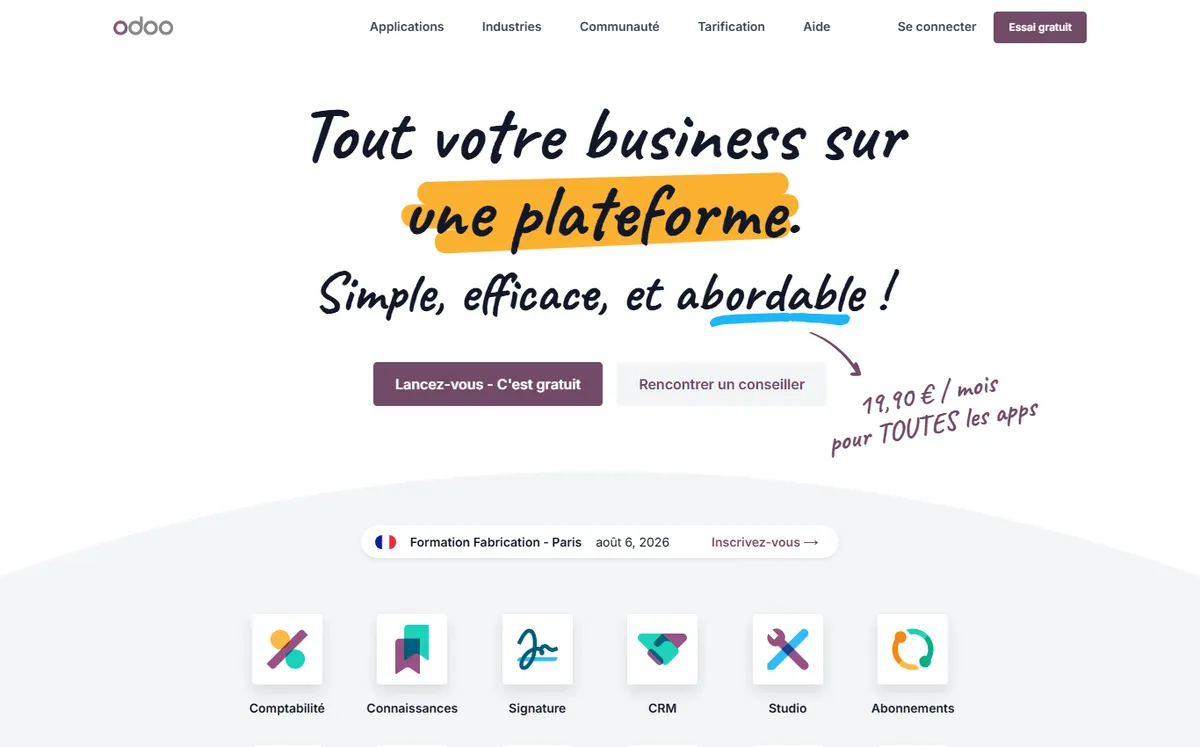
- +
Modular by design: you switch on one app at a time (accounting, sales, inventory, manufacturing, e-commerce) and the scope grows with the business.
- +
Public, transparent pricing, still rare in the ERP market: from $24.90/user/month for the Standard plan billed annually (indicative, July 2026).
- +
Open-source Community edition plus a free One App Free tier to run one application with unlimited users at no cost.
- –
The licence price is not the whole story: a serious deployment almost always goes through an integrator, which inflates the real budget.
- –
Version upgrades and some third-party modules from the Odoo Apps store can add cost and complexity.
Our verdict
Odoo takes our top spot for most SMBs: a modular approach where you switch on app after app (accounting, sales, inventory, manufacturing, e-commerce), transparent public pricing (rare in this market) and a One App Free tier to start with no licence. The real caveat is the cost of a serious deployment, which almost always goes through an integrator.
ERPNext
The best free, open-source ERP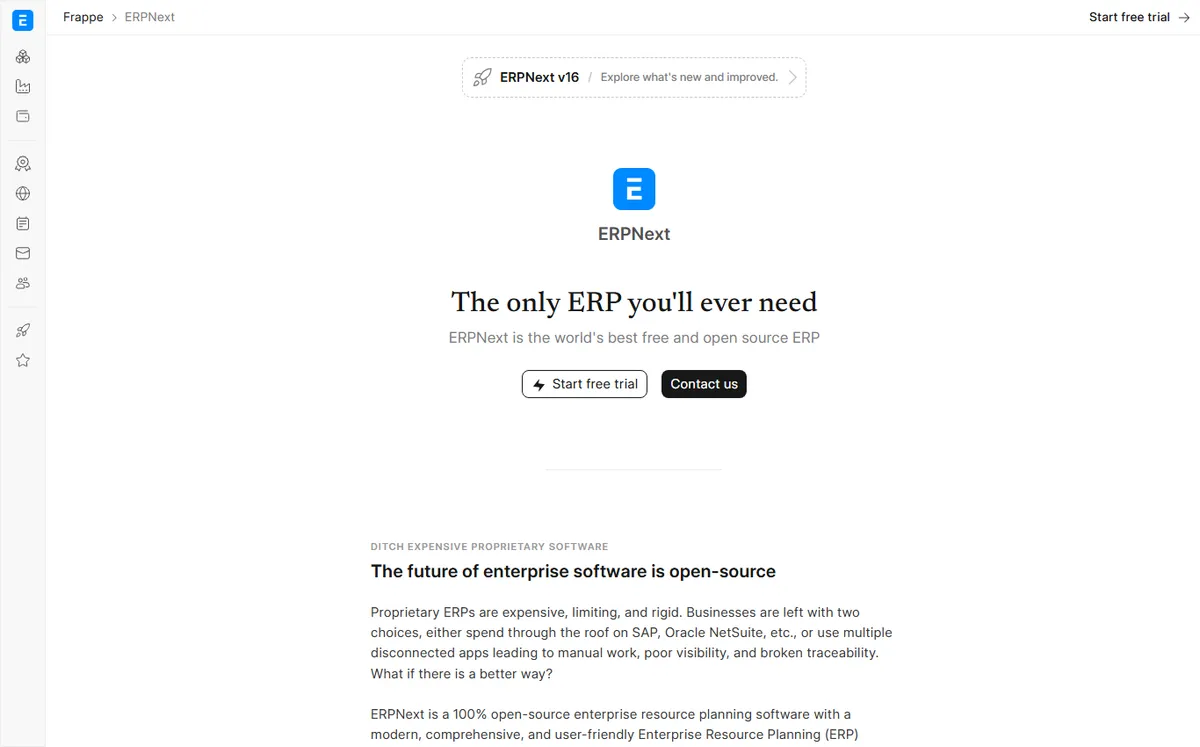
- +
Genuinely free when self-hosted: no licence fees, and the software covers ERP and CRM alike (quotes, invoices, inventory, accounting, projects).
- +
Active worldwide open-source community; managed hosting is available through Frappe Cloud for teams that would rather not run a server.
- +
Modular and lightweight: enable only the modules you need, with a fast learning curve for a small business.
- –
The interface is less polished and less fluid than modern proprietary cloud suites like Dynamics or NetSuite.
- –
“Free” does not mean cost-free: hosting, maintenance, customisation and integration are still on you.
Our verdict
ERPNext is our best free pick: genuinely licence-free when self-hosted, it covers ERP and CRM alike and fits a startup or small business well. In exchange you accept an interface less polished than modern proprietary suites, and a real cost that shifts to hosting, maintenance and integration.
Dynamics 365 Business Central
The most integrated with Microsoft 365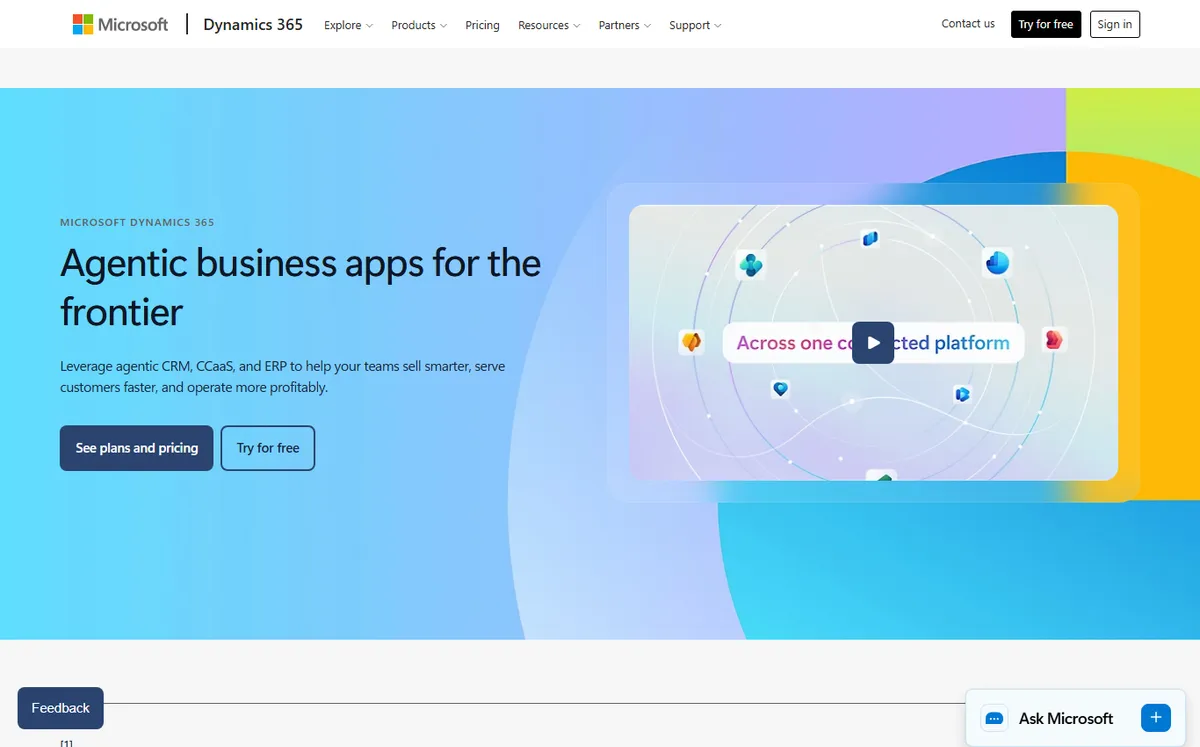
- +
Native integration with Excel, Teams and Outlook: a major advantage for companies already running Microsoft 365.
- +
Full cloud ERP (finance, sales, purchasing, inventory, projects) hosted on Azure, with the Copilot AI assistant built in.
- +
Public reference price: Business Central Essentials from $80/user/month (price effective November 2025).
- –
Deployment runs through a Microsoft partner: on top of the licence sits an implementation cost that is not public.
- –
Powerful but dense: onboarding needs support, and it targets already-structured SMBs. There is also no on-premise option.
Our verdict
Dynamics 365 Business Central shines the moment your company already lives in Microsoft 365: native integration with Excel, Teams and Outlook, a full cloud ERP on Azure and the Copilot assistant. The licence price is public (from $80/user/month), but deployment runs through a Microsoft partner whose cost is not advertised.
Oracle NetSuite
The best all-in-one cloud ERP for scaling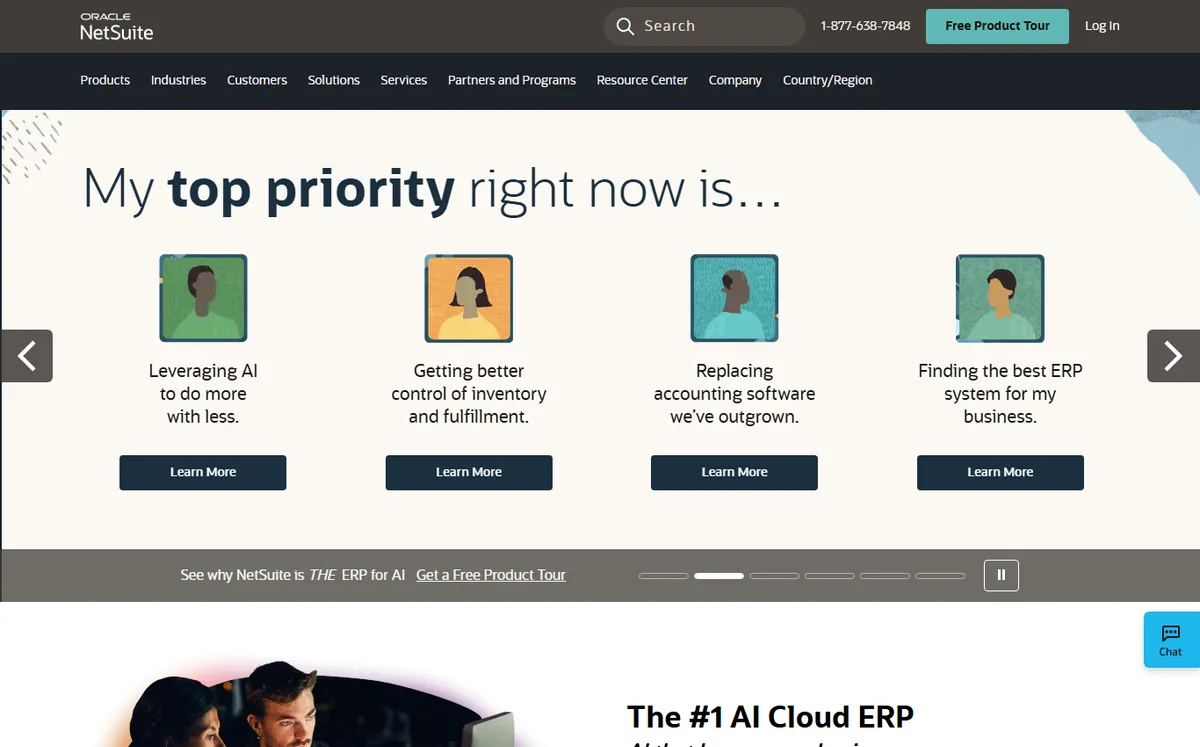
- +
A mature, unified cloud ERP that covers financials, CRM, inventory and e-commerce in one platform, with strong real-time reporting.
- +
Excellent multi-currency, multi-entity and multi-subsidiary handling, ideal for companies expanding internationally.
- +
Highly scalable: many mid-market companies keep NetSuite as they grow from a few million to hundreds of millions in revenue.
- –
Custom pricing only, with a platform fee on top of per-user seats: the effective cost is often higher than the headline per-user rate.
- –
Implementation and administration are demanding; often overkill for a very small business.
Our verdict
Oracle NetSuite is built for fast-scaling mid-market companies: a mature, unified cloud ERP covering financials, CRM, inventory and e-commerce, with excellent multi-currency and multi-subsidiary handling. The trade-offs are custom pricing with a platform fee on top of seats, and a demanding implementation that is often overkill for a very small business.
SAP Business One
The most complete for manufacturing and distribution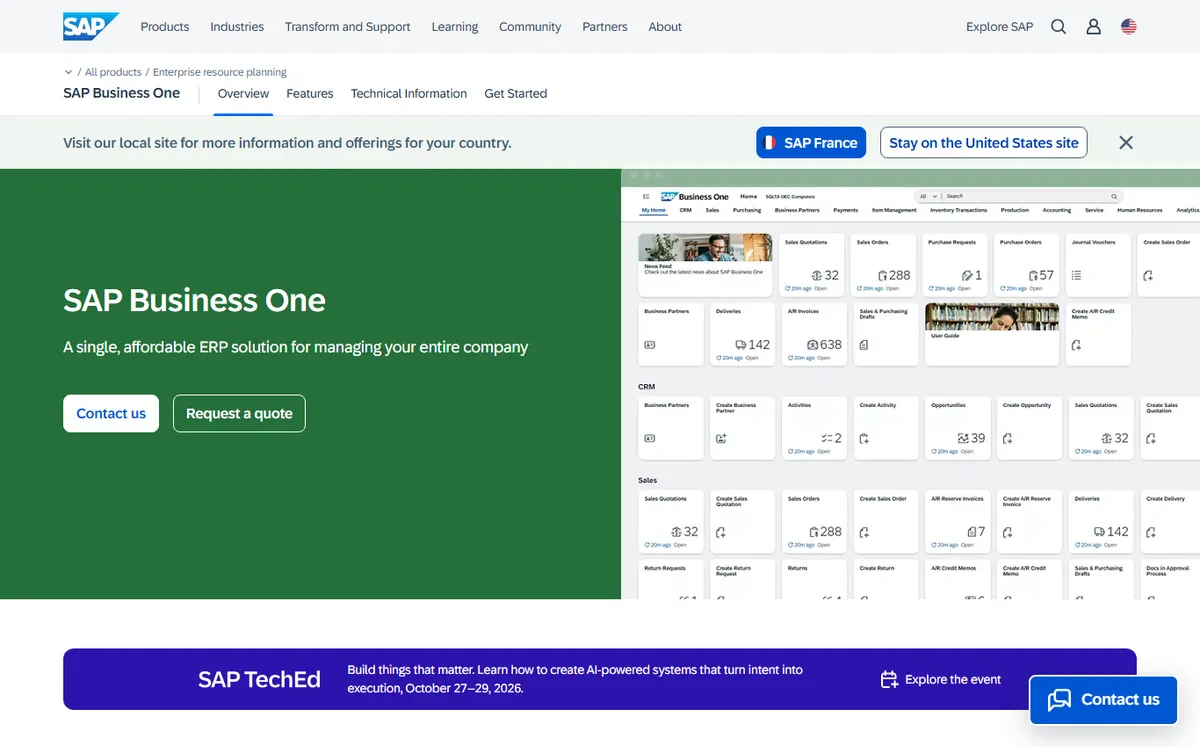
- +
A proven, very complete ERP, especially strong in manufacturing, wholesale distribution and supply-chain management.
- +
Multi-currency and multi-company management suited to businesses operating across borders.
- +
A structuring, long-lasting platform backed by a vast global network of SAP partners.
- –
Custom pricing and a high total cost of ownership: licence, infrastructure and integration all add up.
- –
Often oversized for a small business: the deployment is long and demanding.
Our verdict
SAP Business One targets mid-sized companies and manufacturers with complex processes: a proven, very complete ERP, strong on production, distribution and supply chain, with multi-currency and multi-company for international operations. In return, a high total cost of ownership and a long deployment, often oversized for a small business.
Ready to scope your ERP project?
Odoo covers the vast majority of SMB needs with no entry budget, and grows module by module alongside you.
Our analysis
Comparison: functional coverage, deployment and scalability
Beyond price, an ERP is decided on three battlegrounds: what it can do (functional coverage), how it is hosted (cloud, on-premise, data residency) and how well it grows with you (scalability, customization). Here is our comparative read, to weight against your size and industry.
Our method. Scores are built from vendor documentation, public pricing grids (July 2026), verified G2 and Capterra reviews and our hands-on testing. Each criterion is weighted by how much it matters to a small or mid-sized business.
Functional coverage
Coverage measures the breadth of native modules: finance and accounting, purchasing, sales, inventory and logistics, manufacturing (MRP), project management, HR and payroll, e-commerce. The broader the core, the fewer third-party tools you bolt on.
Native functional breadth · score out of 10
The longer the bar, the wider the scope covered out of the box.
Native modules by platform
✓ native module · ✗ absent or via a third party · “Module” or “Partial” available as an add-on. Scroll the table if needed.
| ERP | Finance / Accounting | Purchasing / Sales | Inventory / Logistics | Manufacturing (MRP) | Projects | HR / Payroll | E-commerce |
|---|---|---|---|---|---|---|---|
| Odoo | ✓ | ✓ | ✓ | ✓ | ✓ | ✓ | ✓ |
| ERPNext | ✓ | ✓ | ✓ | ✓ | ✓ | ✓ | Module |
| Dynamics 365 BC | ✓ | ✓ | ✓ | ✓ | ✓ | Partial | Partial |
| Oracle NetSuite | ✓ | ✓ | ✓ | Module | ✓ | Module | ✓ |
| SAP Business One | ✓ | ✓ | ✓ | ✓ | ✓ | Partial | Partial |
- SAP Business One and Oracle NetSuite offer the widest native footprint, manufacturing and e-commerce included.
- ERPNext covers the ERP-CRM essentials, but handles e-commerce through lighter add-ons.
- Dynamics 365 BC is strong on finance and operations, thinner on native HR/payroll and e-commerce.
Key takeaway. Do not chase maximum coverage on principle: pay for the modules you will actually switch on. A services micro-business does not need an MRP engine.
Deployment, hosting and data residency
The deployment model drives your budget, your data residency and your compliance. Pure cloud, on-premise or hybrid: each ERP has a home turf. This is also where the cloud-only platforms part ways with those you can still self-host.
| ERP | Cloud | On-premise | Hosting | Mobile app | Multi-entity / currency |
|---|---|---|---|---|---|
| Odoo | ✓ | ✓ | Odoo.sh | ✓ | Via module |
| ERPNext | Frappe Cloud | ✓ | Self / Frappe | ✓ | ✓ |
| Dynamics 365 BC | ✓ | ✗ | Azure | ✓ | ✓ |
| Oracle NetSuite | ✓ | ✗ | Oracle Cloud | ✓ | ✓ |
| SAP Business One | ✓ | ✓ | Cloud or on-prem | ✓ | ✓ |
- Cloud-only: Dynamics 365 and NetSuite run as pure SaaS, a plus if you never want to manage a server.
- On-premise: Odoo, ERPNext and SAP Business One can still be installed on your own infrastructure.
- Multi-entity: NetSuite and SAP lead on multi-subsidiary and multi-currency operations at scale.
Key takeaway. If you want a true cloud SaaS with no servers to run, NetSuite and Dynamics 365 fit. If you want the option to self-host or stay on-premise, Odoo, ERPNext and SAP keep that door open.
Scalability and customization
An ERP commits you for years: it must absorb growth (users, volumes, sites, subsidiaries) and bend to your processes without runaway development.
Ability to grow (users, sites, international) · score out of 10
The longer the bar, the better the platform handles heavy load.
- NetSuite and SAP absorb heavy growth and multi-entity, multi-country setups best.
- Odoo customises very finely (open source, framework, Odoo Studio) but needs skills.
- ERPNext plateaus sooner: perfect for a small business, less so for a multi-site enterprise.
Key takeaway. Choose the ERP for your 3-to-5-year trajectory, not just your current size. Migrating ERPs is expensive; better a foundation that follows your growth.
Which ERP for which use case?
In short, here is our recommendation by profile and industry:
| Your profile | Our pick | Why |
|---|---|---|
| SMB | Odoo · ERPNext | Start with no heavy licence, enable modules as you grow |
| Manufacturing | SAP Business One | The most complete MRP, supply chain and multi-site handling |
| Construction | Odoo | Project, purchasing and subcontractor management, modular per job |
| Wholesale / distribution | Oracle NetSuite · SAP | Highly scalable inventory, logistics and purchasing |
| Enterprise / mid-market | NetSuite · Dynamics 365 | Scalability, system integration and compliance at scale |
| International (multi-country) | Oracle NetSuite | Multi-currency, multi-subsidiary and per-country localisation |
Key takeaway. For most SMBs, Odoo remains the best starting point. Reserve NetSuite and SAP for organisations with complex processes or already highly structured operations.
How we built this ranking
Every ERP is assessed across four weighted axes: functional coverage (finance and accounting, purchasing, sales, inventory, manufacturing, projects, HR), model and flexibility (open source or proprietary, modularity, ability to grow with the business), hosting and compliance (data residency, security certifications, regulatory fit) and real cost (licence, but also integration, maintenance and scaling). We favour solutions genuinely suited to small and mid-sized businesses, and we re-evaluate offers whenever a pricing grid changes, which is why the update date sits at the top of the page.
How do you choose the right ERP software?
Before you compare prices, frame your need. An ERP is chosen first on your size and your industry: a services micro-business does not have the same expectations as a mid-sized manufacturer with production lines and inventory. List the modules you genuinely need (invoicing, accounting, purchasing, inventory, manufacturing, projects) rather than aiming for an over-engineered system.
The second reflex is to think in total cost, not just licence price. An open-source ERP like ERPNext shows $0 in licence fees, but hosting, maintenance and integration have a cost. Conversely, a custom-priced solution like NetSuite or SAP can hide a substantial implementation budget. Always ask for a full quote: licences, configuration, data migration, training.
Finally, check hosting and compliance: where your data lives, security certifications, and whether the platform meets your regulatory obligations (tax reporting, e-invoicing that is spreading fast). If your team already lives inside Microsoft 365, the integration of Dynamics 365 Business Central is a strong argument. If you want control and a contained budget, Odoo and ERPNext deserve the first look. To go further, read our guide to choosing an ERP and our ERP hub.
Which ERP fits your profile?
For a startup or a small team on a tight budget, ERPNext when self-hosted or Odoo’s One App Free tier let you start without a heavy licence. For a growing SMB that wants a scalable foundation and a readable price, Odoo is our default recommendation. A company already invested in Microsoft will benefit from evaluating Dynamics 365 Business Central. A fast-scaling mid-market business with multiple entities and currencies will find its match in Oracle NetSuite. Finally, a manufacturer or distributor with complex processes will find in SAP Business One an ERP that measures up, provided it accepts the deployment effort. New to the category? Start with our explainer on what an ERP is.
Frequently asked questions
What is the best ERP software in 2026?
For most small and mid-sized businesses, Odoo offers the best balance of functional coverage, modularity and transparent public pricing (from $24.90/user/month billed annually, indicative July 2026). ERPNext is the best free choice for a startup, Dynamics 365 Business Central is the most integrated with Microsoft 365, Oracle NetSuite is the best all-in-one ERP for scaling mid-market companies, and SAP Business One is the most complete for manufacturing and distribution.
Which open-source ERP should you choose: Odoo or ERPNext?
ERPNext is genuinely free when self-hosted and fits startups and small businesses that want a simple ERP-CRM with no licence. Odoo is richer and more modern, better equipped to grow, but full use is paid (from $24.90/user/month billed annually) and a serious deployment often goes through an integrator.
How much does ERP software cost?
Prices vary enormously. ERPNext is free when self-hosted (hosting and integration remain). Odoo starts at $0 with One App Free, then from $24.90/user/month for the Standard plan billed annually. Dynamics 365 Business Central Essentials starts at $80/user/month. NetSuite and SAP Business One use custom pricing: the total depends on scope, number of users, hosting and implementation partner. Always factor in the implementation budget, not just the licence.
Is an ERP suitable for a small business?
Yes, as long as it stays proportionate. A small business does not need an oversized ERP like SAP. ERPNext when self-hosted or Odoo’s One App Free tier let you centralise quotes, invoices, inventory and accounting without committing a large budget. You switch on only the modules you need and expand the scope as you grow.
What is the difference between an ERP and a CRM?
A CRM (Customer Relationship Management) focuses on the customer relationship and the sales pipeline: contacts, opportunities, follow-ups. An ERP covers the whole business (finance, purchasing, inventory, manufacturing, projects) in a single database, and often includes a CRM module. The ERP is therefore broader and more structuring. For a deeper look, read our ERP vs CRM explainer.