 ChatGPT
ChatGPT review 2026: our full test
ChatGPT is the world’s most used consumer AI assistant, and probably the one you’ve already heard of. Its promise is simple: broad capability, deep learning, and access to a growing ecosystem of tools. We put it through a full hands-on test to settle the question: is ChatGPT still the best choice in 2026, and where does the real value hide? Here is our verdict.
Verdict: the most versatile AI assistant, but not the most privacy-conscious
ChatGPT remains the gold standard for consumer AI assistants: strong GPT-5.6 models, the richest ecosystem (web, vision, GPTs, Deep Research, voice mode, image generation) and a genuinely useful free version. It carries two blind spots: hallucinations and data privacy, and costs climb fast once you leave basic use behind. An excellent default choice, provided you verify responses on sensitive topics.
What to remember
- The richest ecosystem on the market: web, vision, GPTs, Deep Research, voice mode, images.
- The free version stays genuinely useful day to day.
- Two blind spots remain, hallucinations and data privacy.
What we liked
- +
GPT-5.6 models rank among the strongest on the market for reasoning and code.
- +
The richest ecosystem: web, vision, voice, GPTs, Canvas, Deep Research.
- +
A genuinely usable free version for discovery and light work.
- +
Polished interface, mobile and desktop apps, natural voice mode.
What could be better
- –
Hallucinations remain possible: false answers stated with confidence.
- –
Data privacy and GDPR: data processed in the US, opt-out must be set manually.
- –
Costs climb fast (Pro at $200/mo) and the free plan has tight caps.
Spec sheet
- Publisher
- OpenAI (United States)
- Flagship model
- GPT-5.6 (Sol / Terra / Luna)
- Free model
- GPT-5.3 Instant
- Multimodal
- Text, code, image, audio, vision
- Key features
- Web, Deep Research, GPTs, Canvas, voice
- Apps
- Web, iOS, Android, macOS, Windows
- Language
- Native English support
- Plus from
- $20/month USD
Data and pricing indicative, checked July 2026. OpenAI rate card subject to change.
Go for it if
- ✓
You want a versatile assistant for writing, analysis and code.
- ✓
You are testing AI with no budget, the free version is enough to start.
- ✓
You make use of GPTs and deep research.
Look elsewhere if
- ✕
You handle confidential data with no legal framework in place.
- ✕
You need verifiable answers without human review.
- ✕
Your usage is heavy and the per-seat cost becomes decisive.
What is ChatGPT exactly?
ChatGPT is the conversational AI assistant from OpenAI, launched in late 2022 and now the world’s most widely used consumer AI service. Under the hood sits a family of large language models (LLMs) capable of understanding natural language instructions and generating text, code, analysis or images. As of July 2026, the web version runs on the GPT-5.6 generation, available in three tiers (Sol for the heaviest workloads, Terra for daily use, Luna for quick responses), while the free version runs on GPT-5.3 Instant.
In practice, ChatGPT serves writing, summarization, translation, coding, document or image analysis, presentation prep, and task automation via custom assistants. It appeals to curious consumers and working professionals alike who integrate it into their daily workflow.
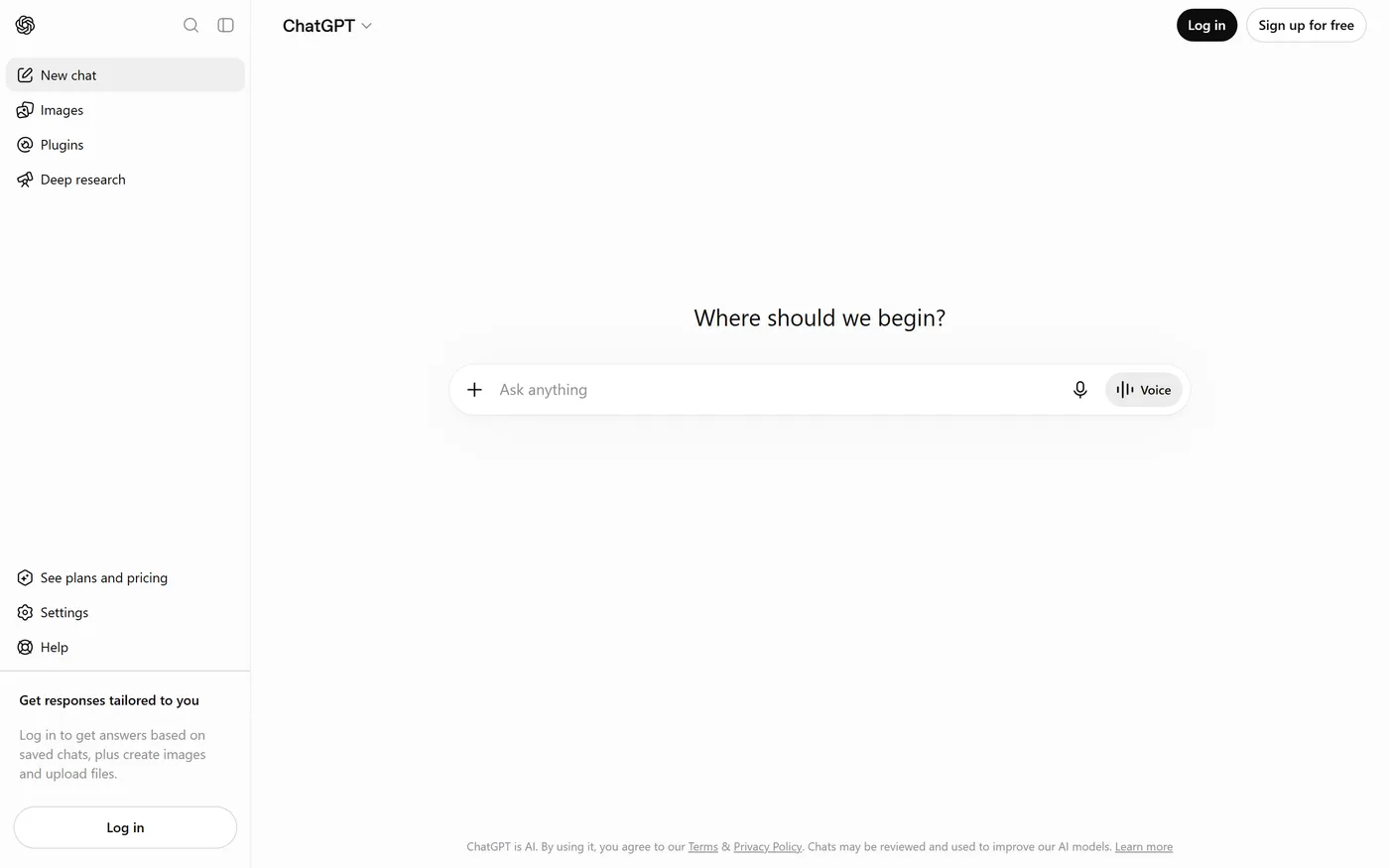
Which models does ChatGPT offer in 2026?
OpenAI launched GPT-5.6 publicly on July 9, 2026, reserved for paid plans. The series comes in three variants based on the power/speed tradeoff you want. On higher plans, the interface auto-selects the best model for context, avoiding manual choice. The free version stays locked on an earlier generation model (GPT-5.3 Instant), faster but less capable at complex reasoning and code. That is the core difference between free and paid: not just usage caps, but the quality of the underlying model.
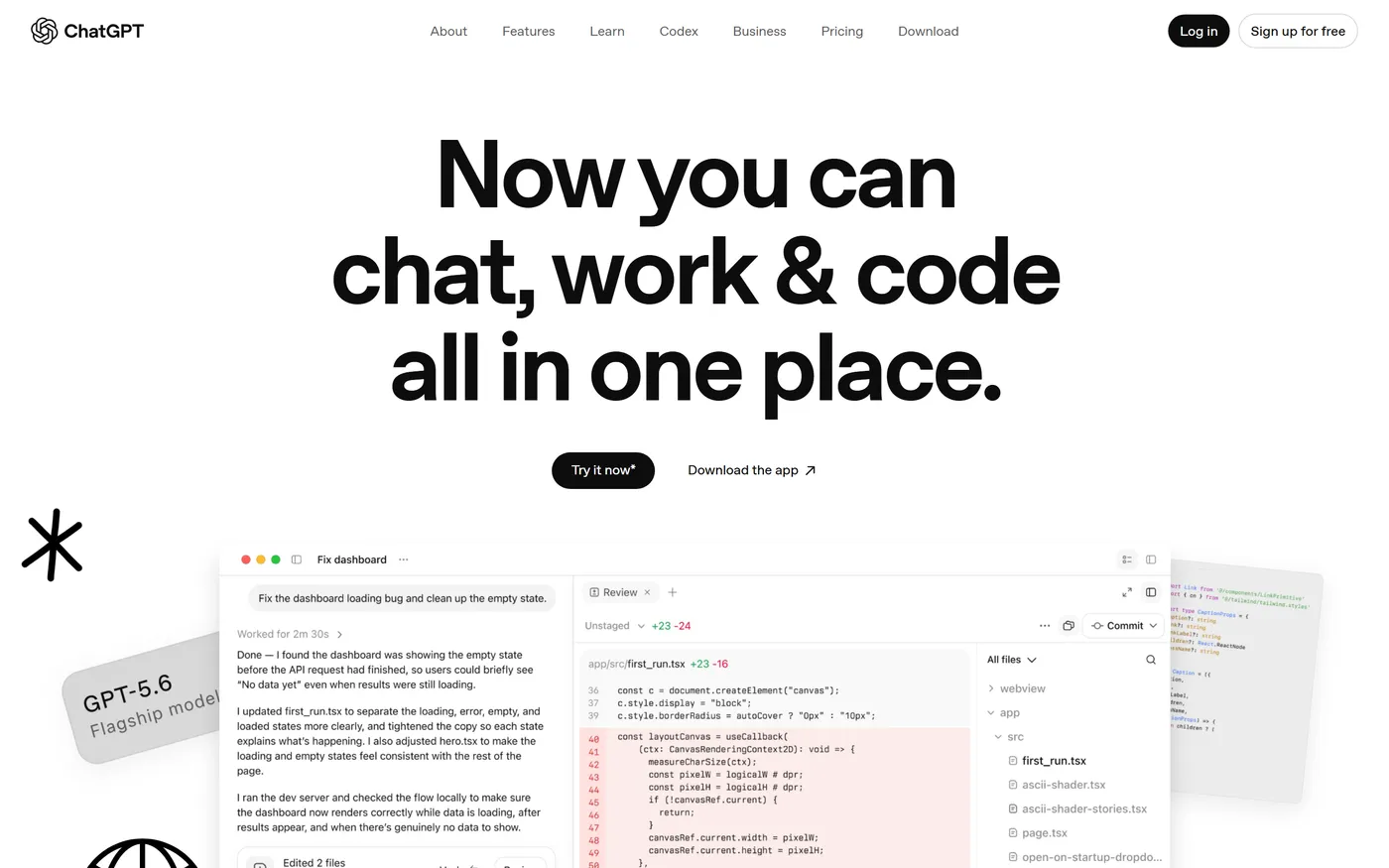
On simple tasks, the gap between free and paid is minimal. It widens sharply on reasoning, code and long document analysis.
What can ChatGPT do (web, vision, GPTs, code)?
This is ChatGPT’s main strength: the breadth of its ecosystem. Beyond plain conversation, it packs in 2026:
- Web search: ChatGPT queries the live web and cites sources, for current answers rather than training-date snapshots.
- Deep Research: longer autonomous research that synthesizes dozens of sources into a documented report (10 sessions per month on Plus, more on Pro).
- Vision: image, screenshot, diagram or document photo analysis.
- Custom GPTs: purpose-built assistants set up for specific use with no coding required, plus a public directory.
- Canvas: a collaborative editing space to rework text or code side by side with the AI.
- Image generation and voice mode: visual creation and voice conversation in near real time.
- Code: writing, debugging and explaining code, one of the areas where GPT-5.6 shines.
Should you choose free or ChatGPT Plus?
The free version stays generous for trying the tool: access to a fast model, web search and image generation, but with tight caps (roughly a dozen messages on advanced models per few hours) and, on some markets, ad insertion. It covers casual use.
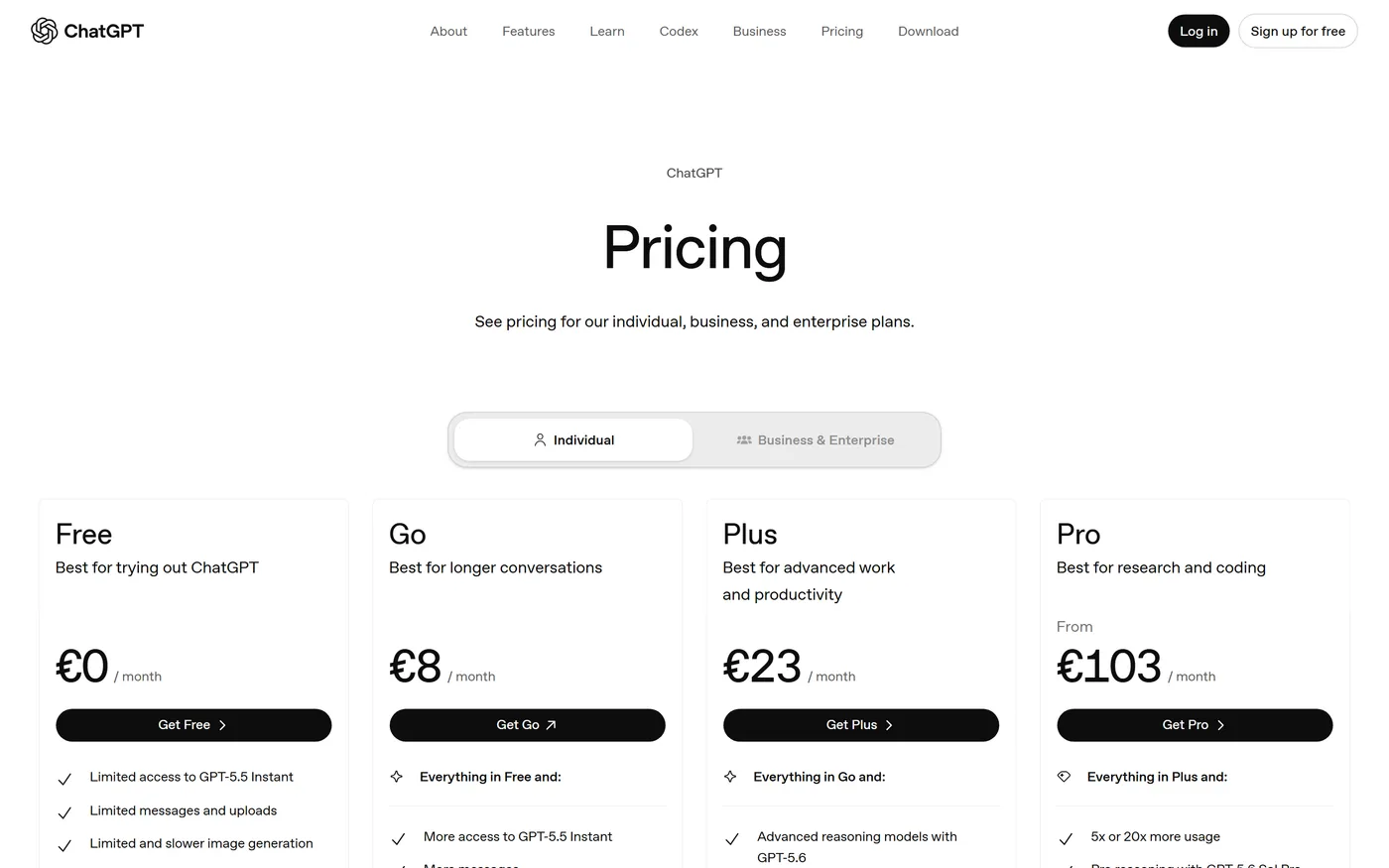
ChatGPT Plus (around $20 USD per month) unlocks GPT-5.6 models, much higher limits, Deep Research, Agent mode, Canvas and advanced voice. It is the tier for steady professional work. Above that, ChatGPT Pro ($200/month) targets power users with ten-fold higher limits and 250 Deep Research sessions per month. Business and Enterprise plans aim at teams, with per-seat billing and stronger data privacy guarantees.
How much does ChatGPT cost in 2026?
| Plan | Indicative price | Best for |
|---|---|---|
| Free | $0 | Discovery, casual use |
| Plus | $20/month USD | Steady professional work |
| Pro | $200/month | Power users, researchers, developers |
| Business | $20-25/seat/month | Teams and SMBs |
| Enterprise | Custom quote | Large organizations |
Indicative prices checked July 2026. Pricing in USD unless noted; OpenAI may adjust rates. Renewal terms vary by region.
What are ChatGPT’s limitations and risks?
Strong as it is, ChatGPT demands caution on three concrete fronts.
1. Hallucinations. The model can assert false information with full confidence: dates, numbers, citations or legal references that do not exist. Risk has dropped with GPT-5.6 but has not vanished. On high-stakes topics (health, law, finance, facts), always verify answers, ideally via its built-in sourced web search.
3. Rising costs. Free is capped fast, Plus remains reasonable, but heavy use (daily Deep Research, large volumes) pushes toward the $200/month Pro tier. And like any US cloud service, you depend on a single vendor and uptime you do not control.
Is ChatGPT right for you?
Yes if you want the most versatile, well-equipped AI assistant for writing, coding, analysis and automation, with almost zero learning curve. The free version lets you test before paying.
Think twice if data sovereignty or strict GDPR compliance without setup is your priority: a European player will feel safer. And if you work mainly on long documents and nuanced editorial analysis, a rival like Claude deserves comparison.
What are the alternatives to ChatGPT?
ChatGPT is not alone. Claude (Anthropic) is often preferred for long writing, document analysis and a more cautious tone. Gemini (Google) shines through Workspace integration and massive context window. For sovereignty, Le Chat by Mistral (French) makes the European case, while Perplexity focuses on sourced search. To tell them apart by your use, see our comparison of the best AI software in 2026, or return to the AI hub for all our guides.
Torn between ChatGPT, Claude and Gemini?
Our comparison ranks them by price, answer quality, privacy and professional use cases.
Frequently asked questions
Is ChatGPT free?
Yes, ChatGPT has a free version with access to a fast model, web search and image generation, but with tight caps (roughly a dozen advanced model messages per few hours). The most powerful features and GPT-5.6 models require a paid subscription.
How much does ChatGPT Plus cost in 2026?
ChatGPT Plus costs $20 USD per month. Pro tier is $200/month for power users, and Business (per seat) and Enterprise (custom quote) plans are available for teams. Prices checked July 2026 and subject to change.
Can ChatGPT make mistakes?
Yes. ChatGPT can produce hallucinations, meaning false answers stated with full confidence (dates, numbers, citations that do not exist). The risk has dropped with GPT-5.6 but persists: on any high-stakes topic, always verify, ideally via its built-in sourced web search.
Are my ChatGPT conversations private?
By default, your conversations can be used to train OpenAI models unless you opt out manually in settings. Data is processed in the US. For sensitive or regulated data, use Business/Enterprise plans (which do not train on your data) or avoid entering personal information.
What is the best alternative to ChatGPT?
It depends on your use: Claude (Anthropic) for long writing and document analysis, Gemini (Google) for Workspace integration, Le Chat by Mistral for European sovereignty, Perplexity for sourced search. Our best AI software comparison 2026 breaks them down in detail.