 monday CRM
monday CRM review 2026: our full test, pricing and limits
monday CRM was not born a CRM: it is one module of the monday.com work platform, tuned for sales. That origin explains everything, for better and worse. For better, a degree of customisation few rivals approach, with no code involved. For worse, a board-based logic that demands discipline, and a three-seat minimum on every plan. It scores highest in our CRM comparison, and still does not suit everyone.
Verdict: the CRM that bends to your process, not the reverse
monday CRM earns the highest satisfaction score in our panel thanks to an immediately readable visual experience: you assemble a CRM from blocks, create your own views, columns and automations without a developer. It is the obvious pick when your business does not fit a standard CRM mould. Two limits matter before signing: billing starts at three seats, and every plan caps the number of active contacts.
What to remember
- The deepest no-code customisation in our comparison, with no developer needed.
- Three seats billed minimum, which rules out solo operators and pairs.
- Every plan caps active contacts, from 1,000 on Basic to 100,000 on Pro.
What we liked
- +
Extreme visual customisation: columns, Kanban, calendar and timeline views to taste.
- +
No code required, including for conditional automations.
- +
CRM and project management in one tool, useful when a signature triggers delivery.
- +
Onboarding feels playful, so non-technical teams actually adopt it.
- +
AI agents built in from the Standard plan, for prospecting and meeting prep.
What could be better
- –
Three seats billed minimum, so $36 a month even if you work alone.
- –
Active contacts and deals are capped by plan, and imports blow past 1,000 fast.
- –
Boards clutter quickly as activity grows, so housekeeping discipline is mandatory.
- –
Less specialised than a pure CRM on advanced sales features such as forecasting.
Spec sheet
- Free plan
- No, except eligible nonprofits
- Free trial
- 14 days, no credit card
- Entry plan
- Basic, $12/seat/month
- Mid plan
- Standard, $17/seat/month
- Top listed plan
- Pro, $28/seat/month
- Minimum seats
- 3
- Active contacts
- 1,000 Basic, 10,000 Standard, 100,000 Pro
- Integrations
- 200+
- Best for
- Teams that want the tool shaped around their process
List prices per seat per month on annual billing, taxes excluded, checked on monday.com’s own pricing page on 3 August 2026. Monthly billing costs more, for example $20 a seat on Standard. The Ultimate plan is quote only.
Go for it if
- ✓
Your sales process is unusual and no off-the-shelf CRM fits it.
- ✓
You want to track the sale and the delivery in the same tool.
- ✓
Your teams are not technical and you need adoption without heavy training.
Look elsewhere if
- ✕
You work alone or as a pair: you will pay for three seats regardless.
- ✕
Your database holds tens of thousands of contacts and budget is tight.
- ✕
You want a specialised CRM with advanced sales forecasting.
What exactly is monday CRM?
monday.com is a work management platform created in 2012 in Israel and used by more than two hundred thousand organisations. Its principle: everything is a board of rows and columns you configure freely, with multiple views and automations triggered by conditions. monday CRM is the sales flavour of that engine, shipped pre-configured for selling.
In practice you get a CRM that is already structured, with leads, contacts, accounts and deals, yet every element stays editable. Adding a « property type » or « square footage » column, creating a view per rep, firing a Slack notification when a deal passes ten thousand dollars: all of it happens with a mouse, in minutes, without filing a ticket with IT.
That flexibility is the actual product. A classic CRM asks you to adapt your process to its data model. monday does the opposite, which explains its adoption in trades that standard tools serve badly: real estate, events, agencies, construction.
What are the key features of monday CRM?
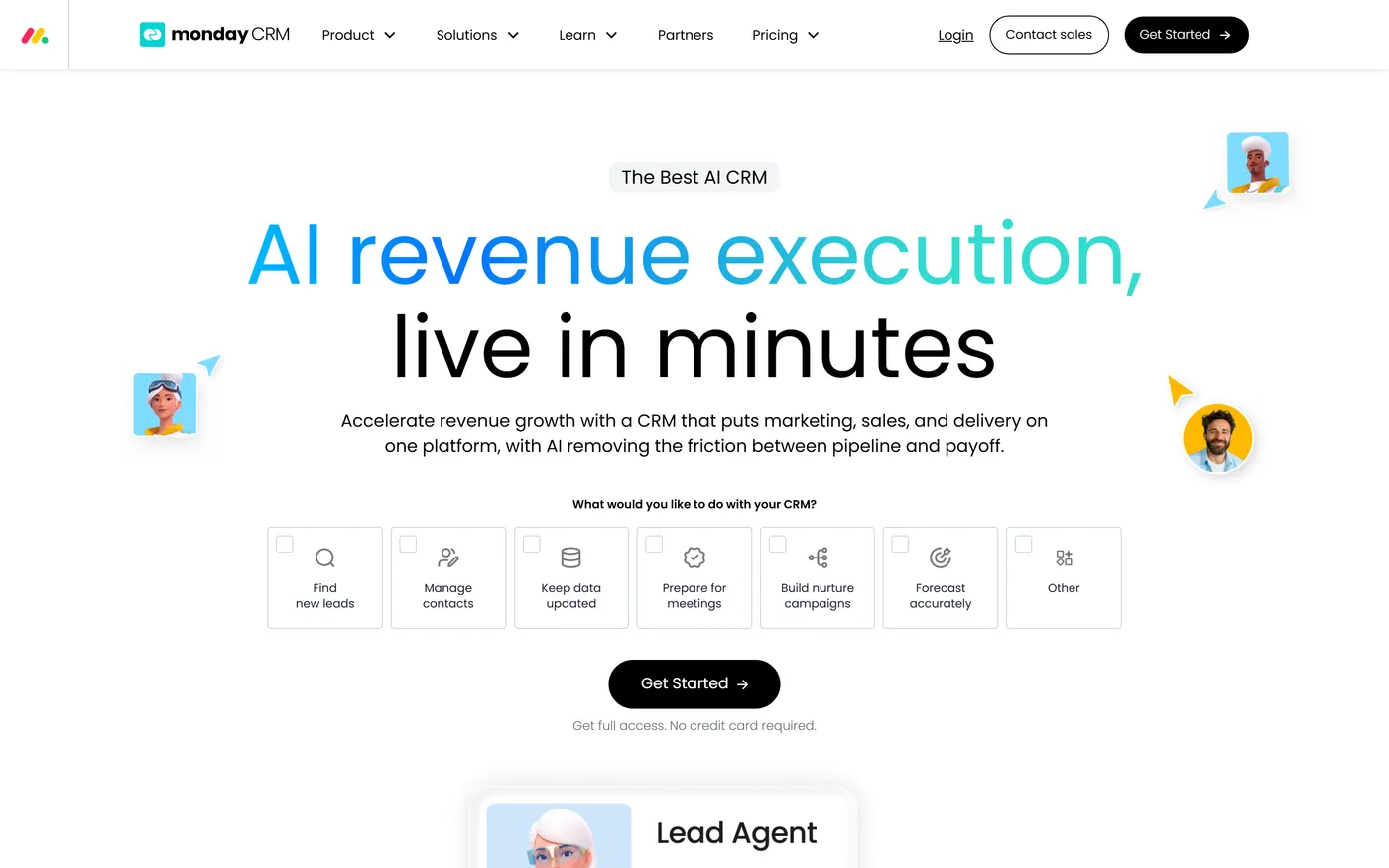
The sales core is complete: pipeline management with Kanban, table, calendar and timeline views, activity tracking, email sync with Gmail and Outlook, email templates, and dashboards that aggregate several boards. Nothing revolutionary, but everything is present and legible.
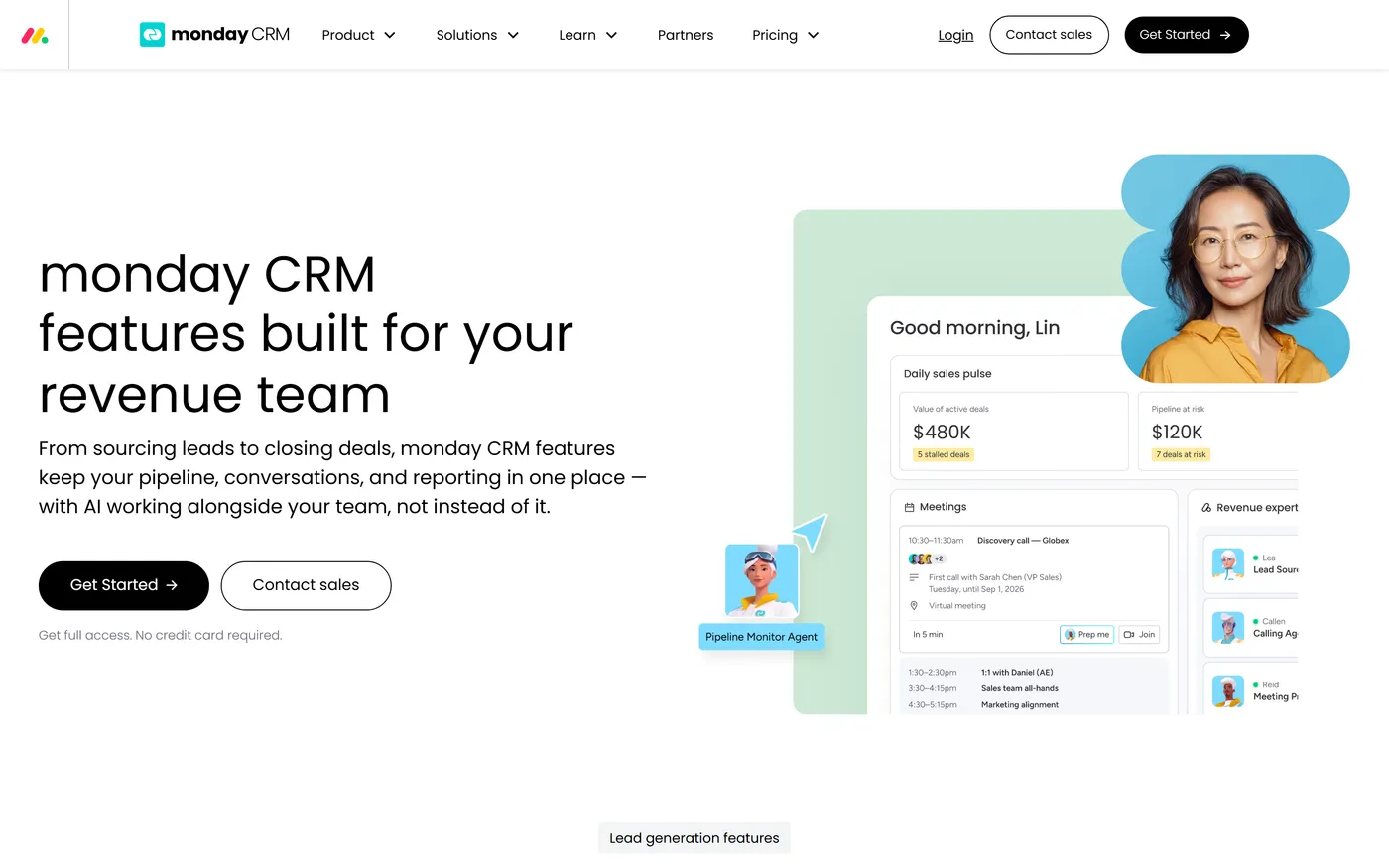
The difference is the no-code automations. A fill-in-the-blanks sentence is enough: « when status changes to Won, create an item in the Delivery board and notify the project manager ». No other platform in this price range makes automation this accessible to a non-technical user. That is what matters in the field, because automations nobody ever configures are worth nothing.
Since 2025 monday has folded in AI agents, available from the Standard plan: prospect sourcing, meeting preparation from past activity, follow-up drafting. They sit alongside 200 native integrations and the ability to wire in anything else through the API or a connector such as Zapier.
The real question with monday is not what the tool can do, but whether your team will keep the boards tidy. Freedom carries a maintenance cost.
Try monday CRM for 14 days
The full trial, with no credit card, lets you rebuild your real process and judge the flexibility.
How much does monday CRM cost? Plans and pricing
monday CRM bills per seat per month, with one rule that changes everything: the minimum is three seats. A solo operator therefore pays for three places. There is no free plan outside the nonprofit programme, but there is a 14-day trial without a credit card.
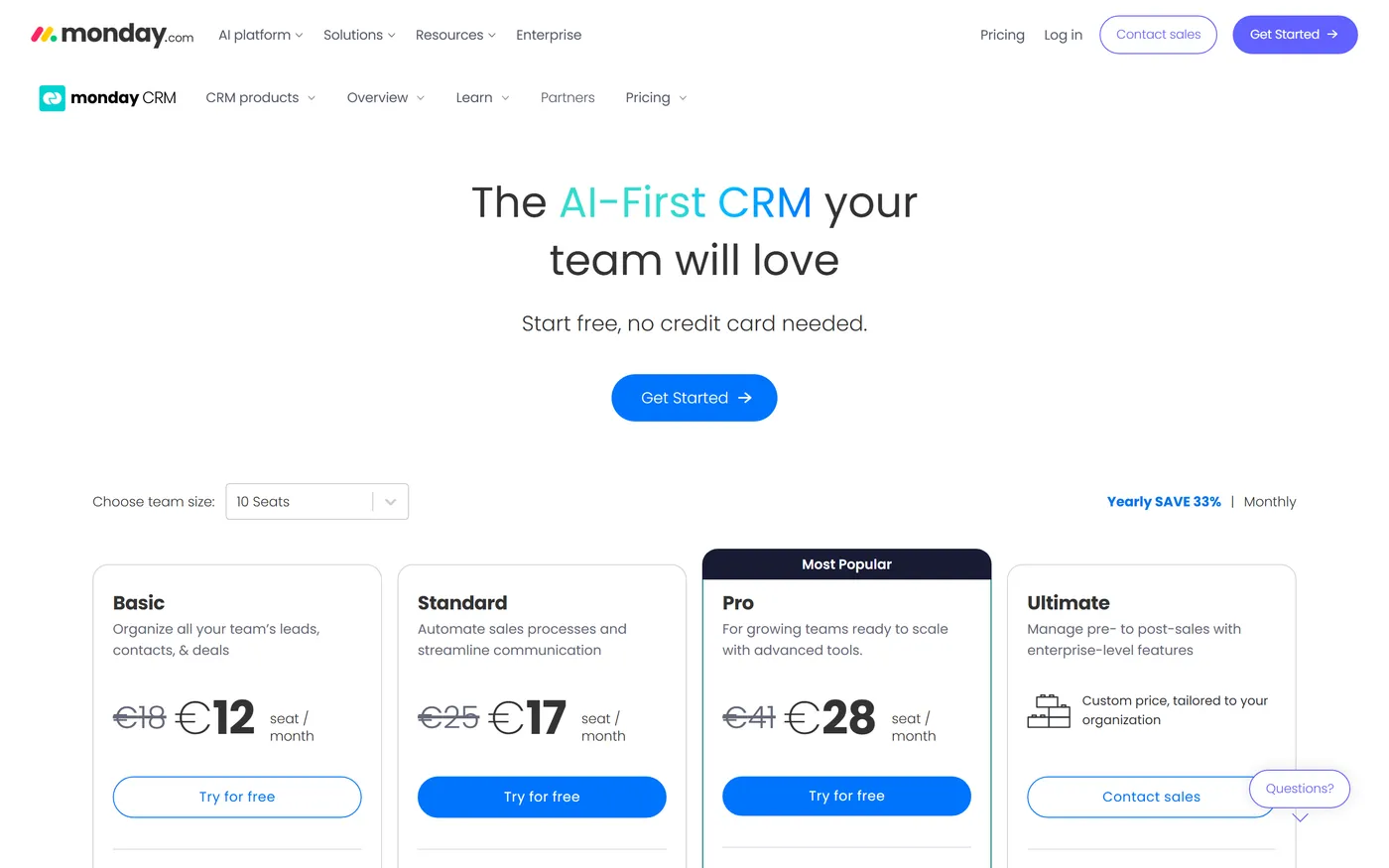
| Plan | Annual billing | Active contacts | Real entry cost |
|---|---|---|---|
| Basic | $12/seat/mo | 1,000 | $36/month |
| Standard | $17/seat/mo | 10,000 | $51/month |
| Pro | $28/seat/mo | 100,000 | $84/month |
| Ultimate | Quote only | Unlimited | Quote only |
List prices per seat per month on annual billing, taxes excluded, checked on 3 August 2026. Monthly billing costs more, for example $20 a seat on Standard. The three-seat minimum applies to every plan.
The real entry ticket is therefore $36 a month on Basic and $51 a month on Standard, the plan we recommend since it unlocks serious automations and the AI agents. For a five-person team on Standard, budget about $85 a month, which sits squarely in the market average.
The number to watch is not the seat price but the active contact cap. One thousand contacts on Basic disappears the moment you import a sales history. Plenty of teams discover the constraint after migrating and move up a tier for that reason alone. Estimate your real volume first, and you avoid an unpleasant surprise in month two.
Who is monday CRM for?
monday CRM is the right call for teams of three to fifty people whose process does not fit the standard mould. Agencies tracking mandates, developers managing units, service firms where a signature triggers production: whenever selling and delivering must live in one tool, the platform pulls ahead.
It is poorly suited to solo operators and pairs because of the three-seat minimum, and to companies that want a CRM that works out of the box with no configuration. Flexibility implies decisions: somebody has to design the boards and keep the house in order. Without that role the tool degrades within months. For a simple, immediate pipeline, Pipedrive will demand far less upkeep.
What are the alternatives to monday CRM?
Pipedrive is the direct alternative if you want an effective pipeline without having to build it, billed from a single user. HubSpot CRM makes sense if you want a free plan and a genuine marketing platform. Zoho CRM offers more advanced sales features for a comparable budget, with stiffer customisation but a sturdier data model.
Our comparison of the best CRM software in 2026 puts these tools head to head on real cost, caps and hosting. The guide to choosing a CRM will help you rank your criteria before you start testing.
Our verdict: 4.6/5, the highest score in our comparison
Check your contact volume before picking a plan, that is the real budget trap of this tool.
Frequently asked questions
Does monday CRM have a free plan?
No, except for eligible nonprofit organisations. Everyone else gets a 14-day free trial with no credit card, after which pricing starts at $12 per seat per month on annual billing, with a three-seat minimum, so $36 a month. Prices checked in August 2026.
Why does monday bill three seats minimum?
It is a commercial rule of the monday.com platform, applied across all its products including the CRM. It effectively excludes solo operators and pairs, whose entry cost stays $36 a month on Basic even with a single real user. If you work alone, a CRM billed per user such as Pipedrive is far cheaper.
How many contacts can monday CRM hold?
The cap depends on the plan: 1,000 active contacts and deals on Basic, 10,000 on Standard, 100,000 on Pro and unlimited on Ultimate. This is the main cause of unplanned upgrades, because importing a sales history usually exceeds a thousand records. Estimate your real volume before choosing.
monday CRM or Pipedrive: which should you choose?
Choose monday CRM if your process is unusual and you want to build the tool your way, with sales and delivery in one place. Choose Pipedrive if you want a standard pipeline that works immediately and bills from a single user. Our comparison of the best CRM software in 2026 costs out both scenarios.