 HubSpot
HubSpot CRM review 2026: our full test
HubSpot CRM is one of the best-known customer relationship management tools on the planet, and probably the one you hear about most. Its promise: a genuinely free CRM with no time limit to get started, then an all-in-one platform (marketing, sales, service) that grows with you. We tested it to settle the question: who is HubSpot really for, and where does the pricing trap hide?
Verdict: the best CRM to start and scale
HubSpot combines one of the most complete free plans on the market, a polished interface and an all-in-one platform that is hard to match for inbound marketing. The only real drawback is cost, which jumps sharply the moment you move up to the Professional tier. Ideal to start with zero budget, worth watching closely as you scale.
What to remember
- One of the most complete free plans around, with no contact limit.
- Polished interface and an all-in-one platform for inbound marketing.
- The bill jumps sharply the moment you move to the Professional tier.
What we liked
- +
The most generous free plan: 2 users, up to 1,000 contacts.
- +
A true all-in-one platform (marketing, sales, service, CMS).
- +
Ecosystem of 1,700+ integrations and a free academy.
- +
Clean interface, fast onboarding, solid support.
What could be better
- –
Cost climbs fast: the Professional tier runs around $90/seat.
- –
Mandatory onboarding fees on Professional and Enterprise plans.
- –
Advanced automation is reserved for the higher tiers.
Spec sheet
- Free plan
- Yes, no time limit
- Users (free)
- 2 maximum
- Max contacts
- 1,000
- Paid from
- ~$15/user/month
- EU data hosting
- Optional (Frankfurt)
- Integrations
- 1,700+
- Built-in AI
- Breeze assistant
- Best for
- Marketing + sales
Entry paid plan (Sales Hub Starter), indicative per user/month on annual billing, recorded July 2026.
Go for it if
- ✓
You are starting your CRM with no budget and want room to grow.
- ✓
Marketing and sales work off the same contact base.
- ✓
You want to plug in many third-party tools without development.
Look elsewhere if
- ✕
Your budget is capped and you will need the Professional features.
- ✕
You are looking for a CRM highly specialised in one trade.
- ✕
You want to host your data yourself.
What exactly is HubSpot CRM?
HubSpot is a US vendor founded in 2006 and a pioneer of inbound marketing (attracting customers with content rather than cold outreach). Its CRM, the foundation that centralizes contacts, companies, deals and conversations, acts as the backbone for its entire platform. Around this free core sit five paid “Hubs”: Marketing Hub, Sales Hub, Service Hub, Content Hub and Operations Hub.
In practice, you can start with the free CRM and sales tracking, then switch on marketing automation, customer service or a website as your needs grow, without changing tools or migrating your data. This unified-platform logic is HubSpot’s core strength, and what sets it apart from pure sales CRMs like Pipedrive.
What are HubSpot CRM’s key features?
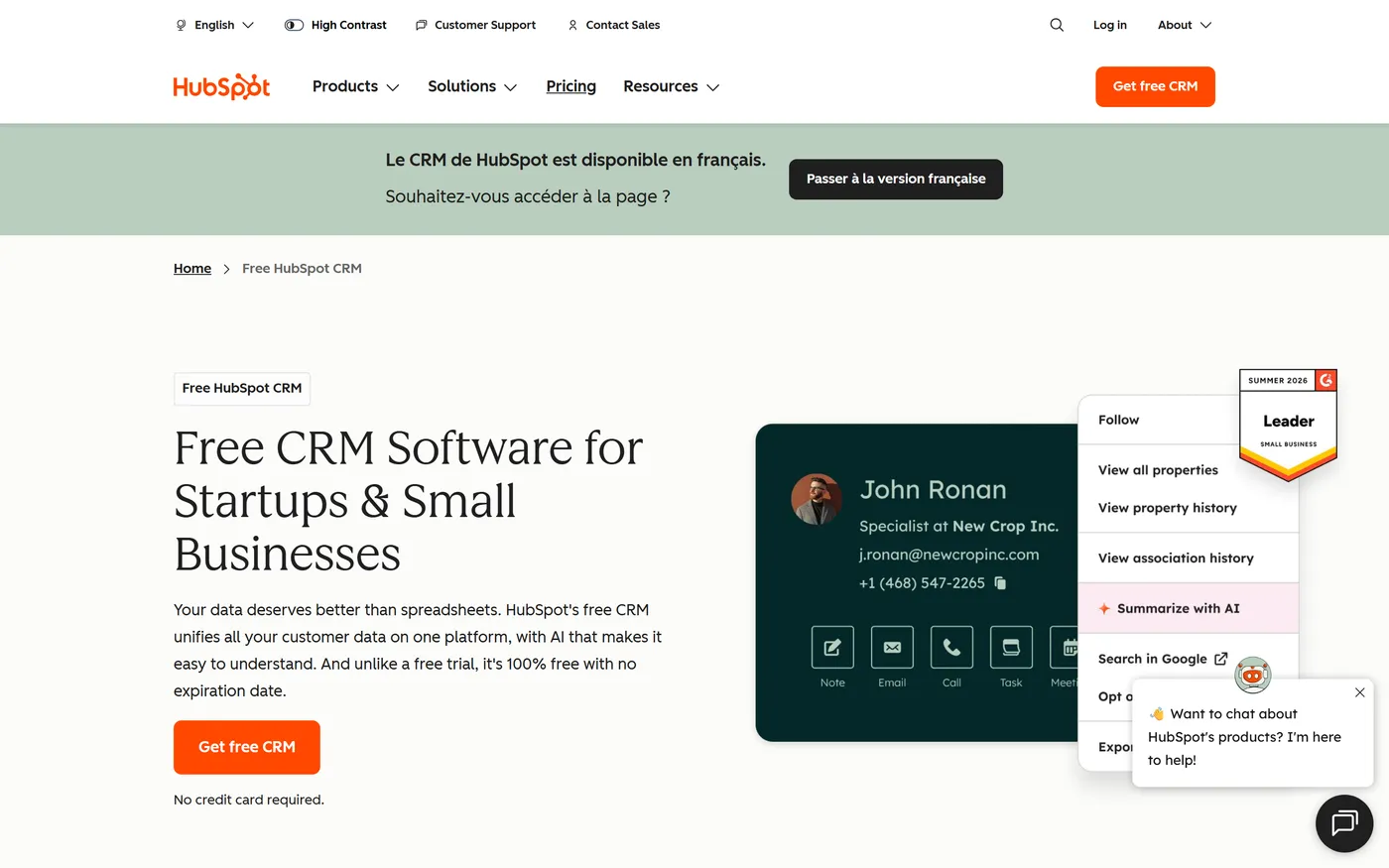
The free CRM already covers a lot: contact and company management, a drag-and-drop deal pipeline, email tracking and open notifications, a meeting scheduler, live chat and forms. Enough to structure a sales operation without spending a cent.
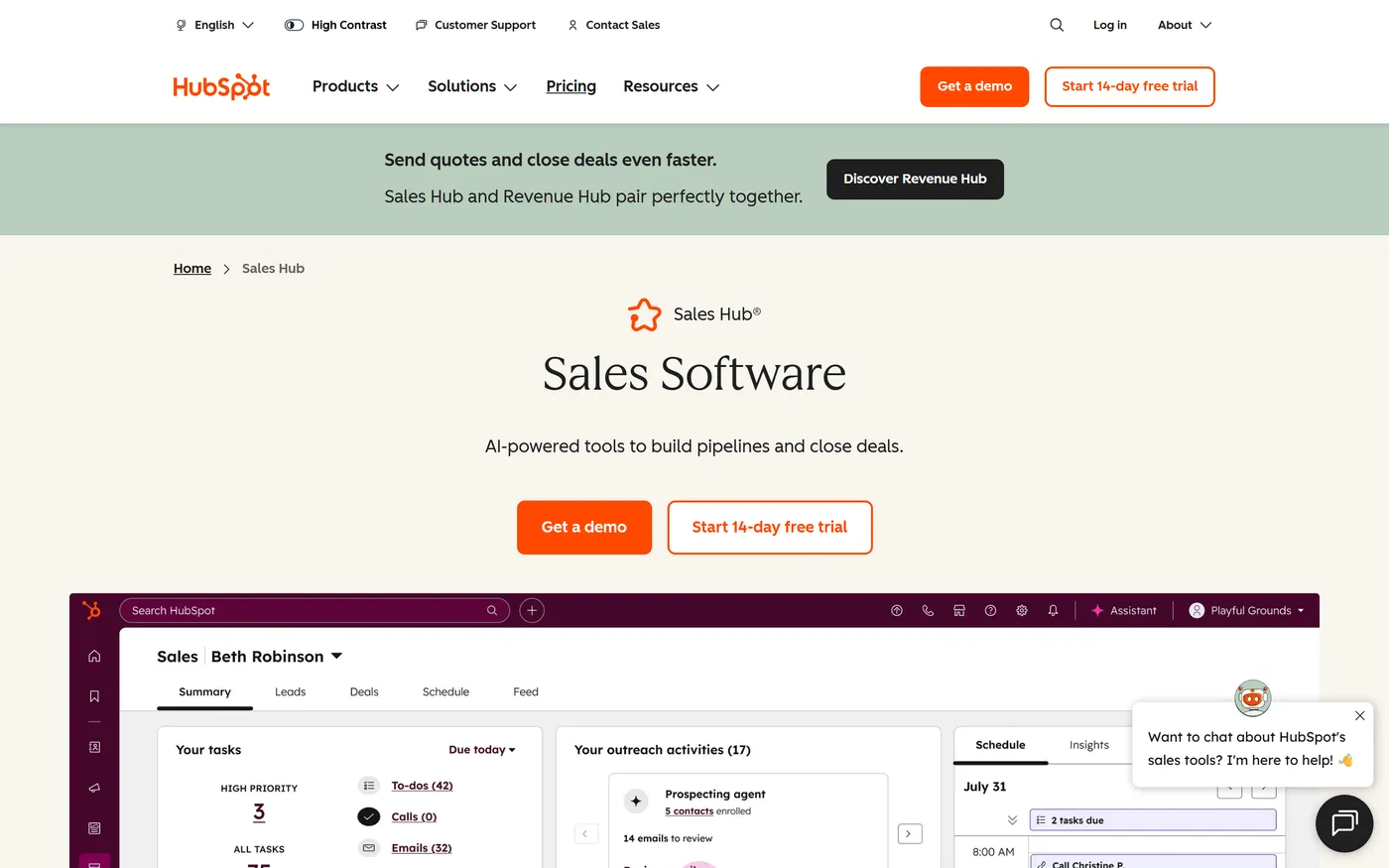
Move up a tier and you unlock the engine room: automated email sequences, lead scoring, marketing automation workflows, custom reporting and sales forecasting. The Breeze AI assistant (HubSpot’s in-house AI) drafts emails, call summaries and content suggestions right inside the interface. A regularly praised strength: the library of 1,700+ integrations (Gmail, Outlook, Slack, Zoom, WooCommerce and more) plus a free training academy that noticeably speeds up onboarding.
HubSpot’s real value is not in any single feature, but in the fact that marketing, sales and service share the same contact database, with no re-entry or shaky syncing.
Try HubSpot CRM for free
The free plan, with no time limit, lets you build your pipeline on zero budget.
How much does HubSpot CRM cost? Plans and pricing
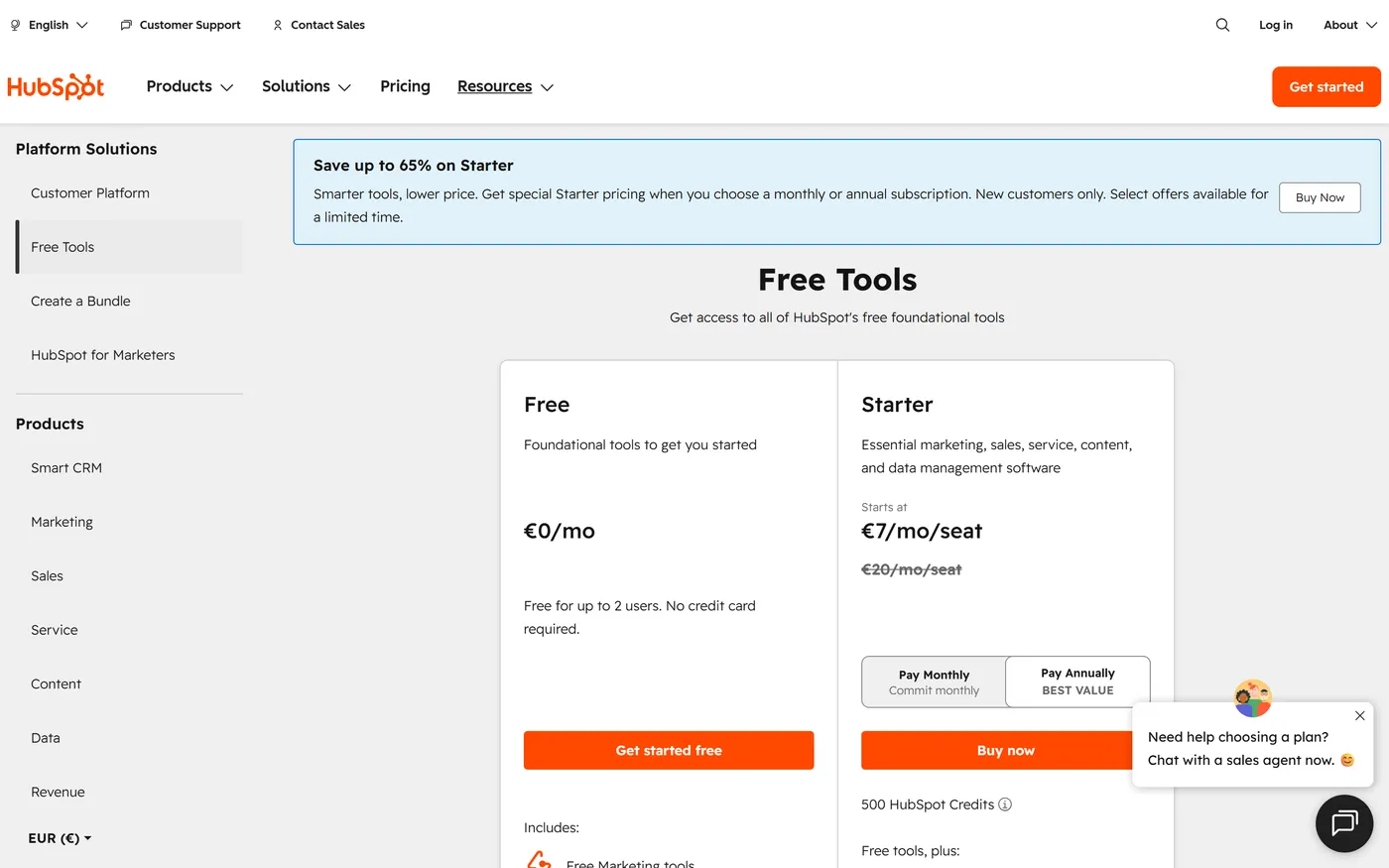
This is where it all comes down. HubSpot runs a very aggressive freemium model at entry, then pricing that climbs fast. The free plan is genuinely free, with no time limit. The first useful paid tier for a sales team is Sales Hub Starter, around $15/user/month on annual billing (about $20 month-to-month).
| Plan | Indicative price | Best for |
|---|---|---|
| Free | $0 | Getting started, testing, solos and micro-teams |
| Sales Hub Starter | ~$15/user/month | Small sales team |
| Sales Hub Professional | ~$90/seat/month + onboarding | SMBs with advanced automation |
Indicative prices per user/month on annual billing, recorded July 2026. The Professional tier comes with a mandatory one-time onboarding fee (around $1,500) and a 5-seat minimum. Check the current price grid before you commit, it changes often.
The real trap is not the sticker price, but the step between Starter and Professional. Many companies adopt HubSpot for its free plan, come to rely on the advanced automation, then discover the bill has multiplied several times over. Budget for that jump from the start if you know you will scale.
Who is HubSpot CRM for?
HubSpot is the default choice for a small business or SMB with an inbound focus that wants a credible free CRM today and the option to add marketing automation tomorrow, without switching tools. Freelancers and small teams benefit from a feature-rich free plan, even if the number of free seats is now capped at two.
Conversely, if your need is a pure sales pipeline with no marketing ambition, a simpler and cheaper solution will do the job. And if you know you will hit the Professional tier quickly, compare the total cost with alternatives that scale more gently before you lock yourself into the ecosystem.
What are the alternatives to HubSpot CRM?
Three competitors are worth a look depending on your profile. Pipedrive offers the most intuitive sales pipeline on the market, perfect if you want immediate simplicity, but with no free plan. Zoho CRM delivers the best features-to-price ratio, free for up to 3 users and paid from around $14, at the cost of a denser interface. Finally, monday CRM is the most visual and flexible option, great for teams that already live in a work-management board and want their pipeline in the same place.
To line them up side by side on real pricing, hosting and simplicity, see our best CRM software 2026 comparison. And if you are still weighing up the criteria, our CRM hub gathers all our guides, tests and definitions.
Our verdict: 4.4/5, start on zero budget
Create your free account, then budget for the upgrade if you know you will scale.
Frequently asked questions
Is HubSpot CRM really free?
Yes. HubSpot’s CRM is free with no time limit, for up to 2 users and 1,000 contacts. The advanced features (automation, in-depth reporting) stay on the paid plans, starting at around $15/user/month for Sales Hub Starter on annual billing, a price recorded in July 2026.
Why does HubSpot’s price climb so much?
The step is steep between Starter (~$15) and the Professional tier (~$90/seat/month), plus a mandatory one-time onboarding fee and a 5-seat minimum. Advanced automation and custom reporting are reserved for these higher plans, which mechanically pushes growing teams toward Professional. You should budget for that increase from the start.
Is HubSpot data hosted in Europe?
HubSpot offers optional data hosting in the European Union (a Frankfurt data center), an important point for GDPR compliance for European businesses. Support is available in several languages.
HubSpot or Pipedrive: which should you choose?
HubSpot wins if you want a free CRM and a scalable all-in-one marketing-plus-sales platform. Pipedrive is better if your need is a pure sales pipeline, ultra-simple and operational within minutes, provided you accept the lack of a free plan. See our best CRM software 2026 comparison to decide based on your profile.