 Odoo
OdooOdoo review 2026: our full test (features, pricing)
Verdict: the most versatile modular ERP
Odoo is an open source ERP from Belgium that covers almost every need of a growing business through 40+ official apps wired to a single database. The One App Free tier and a public per user price make it accessible, but the bill climbs quickly as modules stack up, and a real rollout usually calls for an integration partner.
What to remember
- More than 40 official apps wired to a single database.
- The One App Free tier and a public per-user price make the ERP accessible.
- The bill climbs fast as modules stack up, and a real rollout usually needs an integration partner.
What we liked
- +
Rare modularity: you switch on apps one by one (sales, inventory, accounting, projects and more).
- +
One App Free tier with unlimited users to get started.
- +
Open source code and Odoo Studio to customize without starting from scratch.
- +
Modern, consistent interface from one module to the next.
What could be better
- –
Cost ramps up fast: the per user price covers every app, but the total grows with each seat.
- –
Complex setup: a serious deployment often goes through a paid integrator.
- –
Uneven documentation and support hour packs billed separately.
Spec sheet
- Vendor
- Odoo S.A. (Belgium)
- Type
- Modular open source ERP
- Official apps
- 40+
- Deployment
- Odoo Online, Odoo.sh, on-premise
- Free tier
- One App Free (1 app)
- G2 rating
- 4.2/5
- Capterra rating
- 4.2/5
- Starting price
- $31.10/user/month
Standard plan, annual billing, US pricelist recorded on odoo.com in July 2026.
Go for it if
- ✓
You want to cover several business areas with a single tool.
- ✓
You accept configuration work to avoid a bespoke ERP.
- ✓
You are looking for an auditable open-source solution.
Look elsewhere if
- ✕
You have neither time nor budget for a setup phase.
- ✕
You only need one function, a specialised tool will be faster.
- ✕
You want a total cost known upfront, with no integrator.
What is Odoo, exactly?
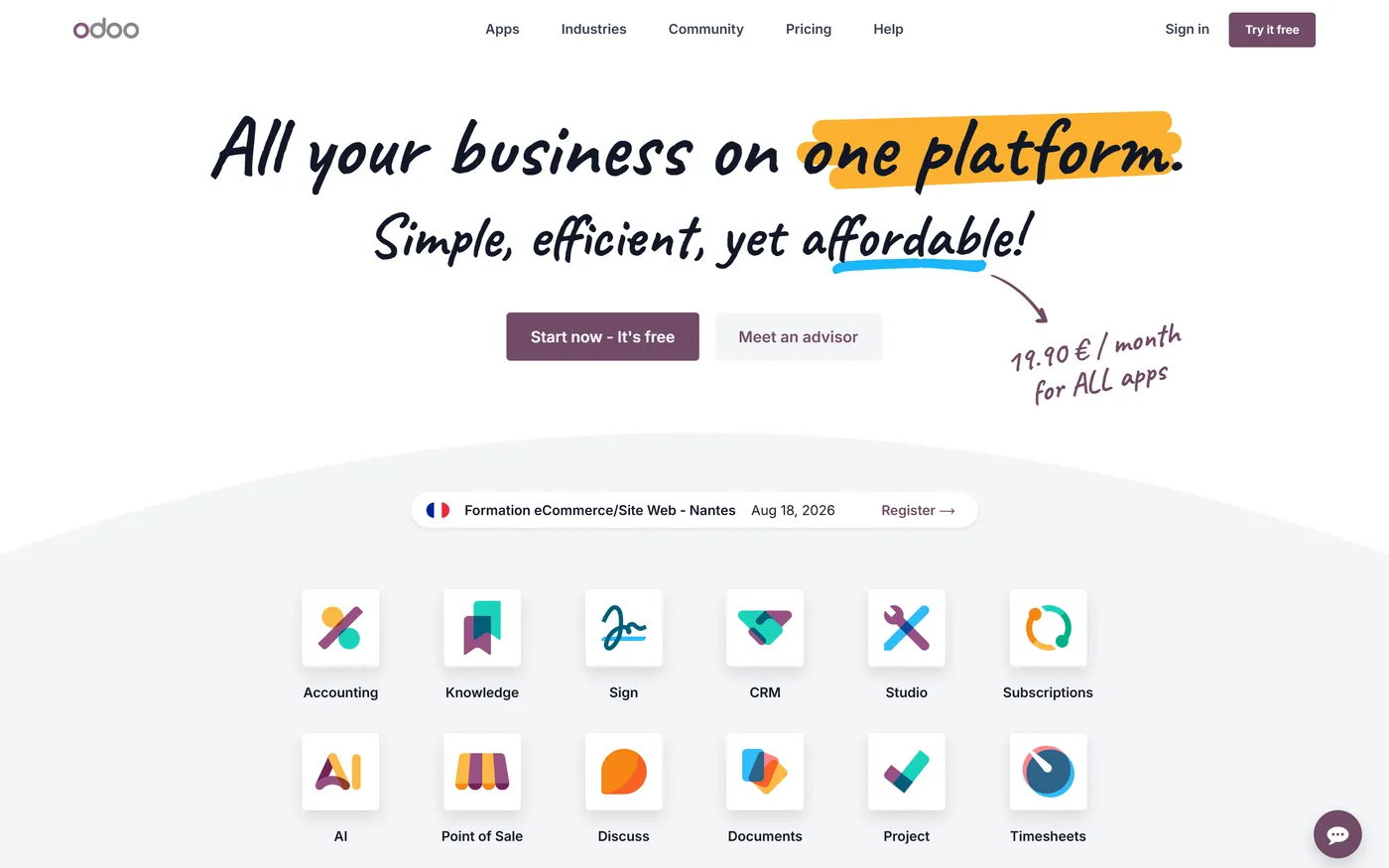
Odoo is an open source ERP built in Belgium and designed as a suite of applications that share a single database. In practice, instead of buying one large monolithic system, you switch on the modules you need: CRM, sales, invoicing, accounting, inventory, purchasing, manufacturing, projects, HR, website or point of sale. Each app you add talks to the others, which removes the double data entry between sales, logistics and finance.
This modular positioning explains its popularity with small and mid sized businesses worldwide: you start small, then extend the scope at the pace of the company. Odoo claims more than 40 official applications, backed by thousands of community modules published on its marketplace.
What modules does Odoo offer?
Odoo’s logic is to be a genuine all-in-one platform. The most used building blocks on the management side:
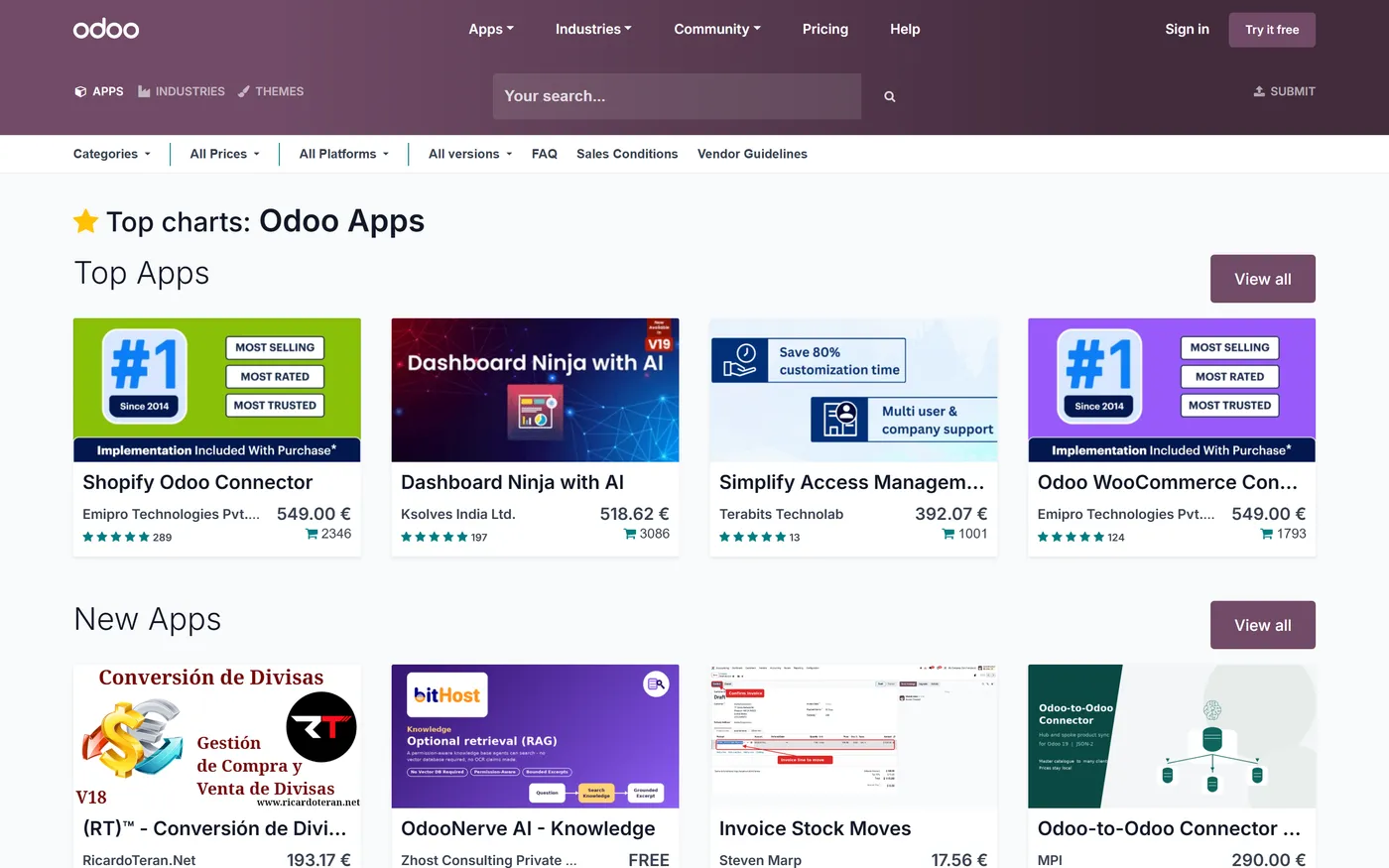
- Finance: accounting, invoicing, expenses, timesheets.
- Sales & customer relations: CRM, quotes, subscriptions, point of sale.
- Supply chain: inventory management, purchasing, manufacturing (MRP), quality.
- Operations: projects, planning, maintenance, field service.
- HR & website: recruitment, time off, payroll (by country), e-commerce, CMS.
It is this functional coverage that sets Odoo apart from a simple invoicing tool or a standalone CRM. To understand where an ERP stops and where a sales tool begins, our ERP hub breaks down the scope of an integrated management suite.
Want to try Odoo yourself?
The One App Free tier lets you start with a single application, no credit card required.
How much does Odoo cost in 2026?
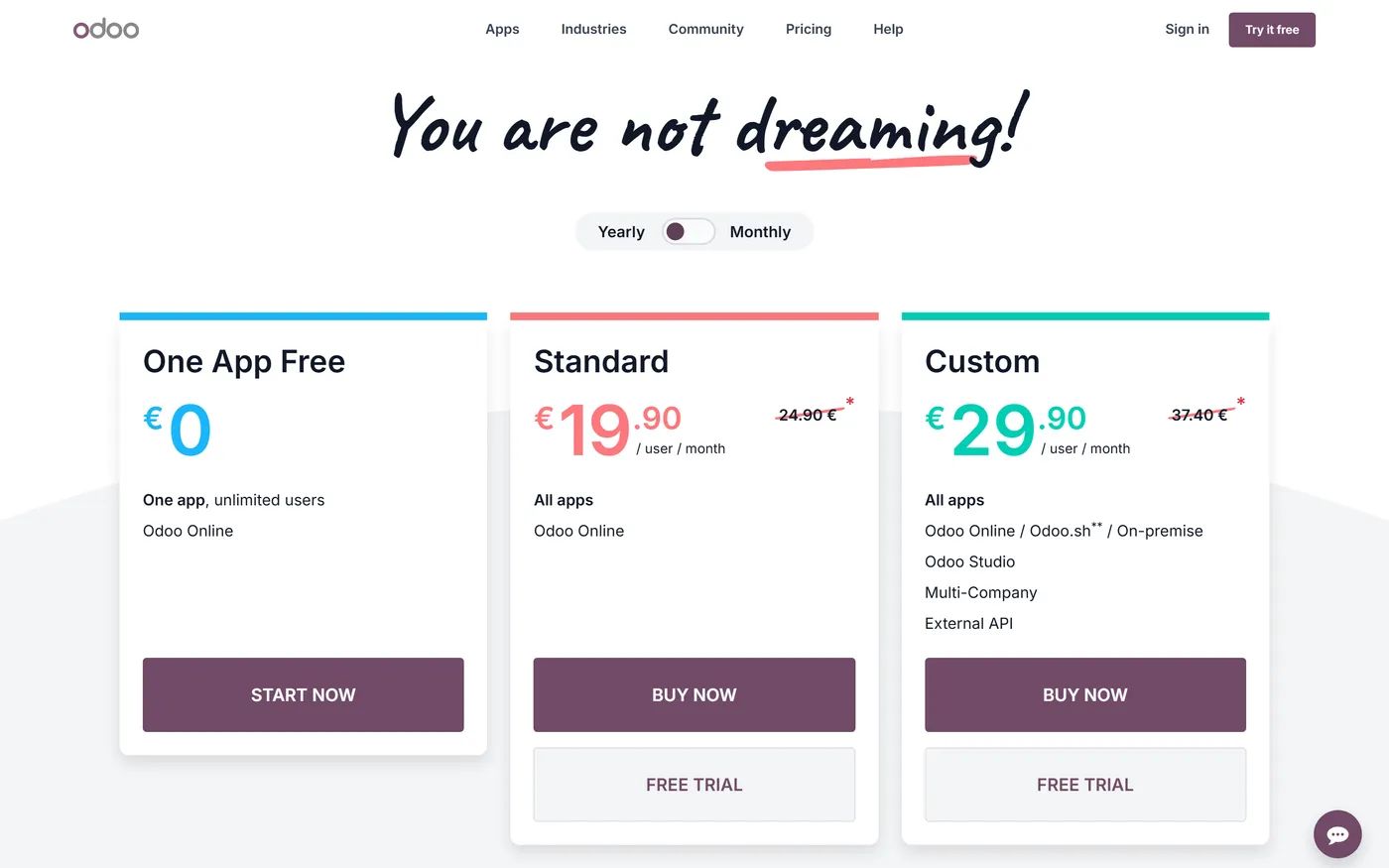
Odoo is one of the few ERPs to publish a public price, which makes comparison easier. Three plans coexist, billed per user per month:
| Plan | Price (annual) | Key contents |
|---|---|---|
| One App Free | $0 | 1 application, unlimited users, Odoo Online |
| Standard | $31.10/user/month | All apps, Odoo Online hosting, support included |
| Custom | $61.00/user/month | Standard + Odoo Studio, multi-company, on-premise, API |
Indicative prices from the US pricelist on odoo.com, recorded July 2026, annual billing. On monthly billing without commitment, expect around $38.90 (Standard) and $76.20 (Custom) per user. Odoo prices vary by country, so check your local pricelist. These figures cover the license only, not implementation or training.
The classic trap: the per user price stays the same regardless of how many apps you enable, but it multiplies by the number of seats. For a 20 person team on the Standard plan, you quickly pass several thousand dollars a year, before even counting the rollout. Conversely, a very small business that only needs one module (invoicing, for example) can stay on the One App Free tier.
The license fee is often only part of the total budget: implementation, data migration and training weigh just as heavily on an ERP project.
What we liked about Odoo
The first strength is flexibility. Few solutions let you start with a single free app, then progressively plug in accounting, inventory or manufacturing without switching tools. The interface is consistent and modern across modules, which limits friction for users.
The second strength is openness. The open source core, Odoo Studio and API access (on the Custom plan) let you customize processes and automate tasks without starting from a blank page. For a company with specific needs, that is a real differentiator against closed ERPs.
What could be better
Two limits come up repeatedly in our tests and in verified reviews (G2, Capterra). First, the rising cost: the per user model becomes heavy as soon as you equip the whole company, and custom development or support hour packs add to the bill.
Second, the setup complexity. Odoo is powerful, but a full deployment (accounting configuration, workflows, data migration) goes well beyond what a single user can handle. Most businesses go through an integrator, which represents an implementation cost that often exceeds the license itself. Add uneven official documentation, and the learning curve can be steep without support. It is worth noting Odoo scores 4.2/5 on both G2 and Capterra but a far more polarized 3.1/5 on Trustpilot, where reviewers focus on support response times and billing.
Who is Odoo for?
Odoo primarily targets small and mid sized businesses that want to unify their management in a single tool and accept investing in a structured rollout. It suits growing companies that know they will add modules over time, as well as those with atypical processes that require customization.
Conversely, a freelancer or micro business that only needs to invoice will find Odoo oversized, unless they stick to the One App Free tier. To weigh options by company size and sector, our best ERP software comparison reviews the decisive criteria.
What are the alternatives to Odoo?
If Odoo does not fit your context, two paths stand out on the global market:
- ERPNext: an open source ERP/CRM, free when self-hosted. The software is free; only hosting, setup and maintenance carry a cost (managed cloud plans start around $10/user/month, recorded July 2026). Lighter than Odoo, it appeals to small and mid sized businesses that want the essentials without an overbuilt system.
- NetSuite (Oracle): an established cloud ERP aimed at mid market and larger companies, with strong finance and multi-entity capabilities. Its pricing is generally custom pricing, quoted by modules and number of users, and typically sits well above Odoo.
To compare Odoo, ERPNext, NetSuite and other ERPs side by side, see our best ERP software 2026 comparison, where we rank solutions by real cost, functional coverage and fit for growing businesses.
Is Odoo the right ERP for you?
Compare it against ERPNext, NetSuite and SAP in our up to date ranking of the best ERPs.
Frequently asked questions
Is Odoo really free?
Partly. The One App Free tier lets you use a single application with unlimited users at no cost. As soon as you install a second app, you move to the Standard plan, billed $31.10/user/month on annual billing (US pricelist, odoo.com, July 2026). The open source Community edition is also free to download but requires hosting and technical skills.
How much does Odoo cost for a small business?
The Standard plan is $31.10/user/month and the Custom plan is $61.00/user/month on annual billing (US pricelist, July 2026). The total cost depends mostly on the number of users and the implementation: data migration, configuration and training often make up a large share of the budget, beyond the license alone. Prices vary by country.
What is the difference between Odoo’s Standard and Custom plans?
The Standard plan gives access to every application on Odoo Online. The Custom plan adds Odoo Studio (advanced customization), multi-company management, on-premise or Odoo.sh hosting and API access. It is aimed at companies that want to build custom features or run several entities in a single database.
Odoo or ERPNext: which should you choose?
Odoo is more complete and more customizable, but pricier and more complex to deploy. ERPNext, open source, is free when self-hosted and simpler, ideal for a small or mid sized business with standard needs. The choice depends on your implementation budget and your need for customization, detailed in our best ERP software comparison.