Best auto repair shop software 2026: our comparison of the top 6 tools
A shop management system (SMS) does far more than invoice a repair order. It must connect work orders to parts and labor, apply manufacturer-recommended times, track multi-site jobs, manage customer communication and payment, and keep the books straight. We compared cloud and desktop platforms built specifically for independent repair shops, not large dealer networks. Here is our 2026 selection, ranked on coverage of the shop workflow, ease of use, pricing and whether the tool actually helps you run faster with fewer errors.

Our picks at a glance
Our choiceTekmetric, the market leader for multi-site shops, with powerful reporting and integrations, designed by a former shop owner.
See ↓ Best UXShopmonkey, the most intuitive interface in the market, with strong support and rapid feature updates.
See ↓ Best onboardingAutoLeap, highest satisfaction for onboarding and support, with QuickBooks integration and a virtual receptionist add-on.
See ↓ Best for approval ratesShop-Ware, a premium option with the best customer portal and inspection workflow, designed for shops chasing higher margins.
See ↓ Most repair dataMitchell 1 Manager SE, the legacy leader with 100+ years of repair procedures and OEM data, backed by Snap-on.
See ↓At a glance
What is the comparison of the best auto repair shop software?
| Software | Rating | Type | Work order management | Deployment | From | |
|---|---|---|---|---|---|---|
| Tekmetric Our choice | ★★★★★ 4.9 | Cloud SMS | ✓ complete | Cloud | $199 | See → |
| Shopmonkey | ★★★★½ 4.6 | Cloud SMS | ✓ complete | Cloud | $239 | See → |
| AutoLeap | ★★★★★ 4.8 | Cloud SMS | ✓ complete | Cloud | $199 | See → |
| Shop-Ware | ★★★★★ 4.9 | Cloud SMS | ✓ complete | Cloud | Quote | See → |
| Mitchell 1 Manager SE | ★★★★☆ 4.0 | Desktop + Cloud | ✓ complete | Windows/cloud | Quote | See → |
| Shop Boss | ★★★★☆ 4.5 | Cloud SMS | ✓ complete | Cloud | $199 | See → |
Indicative starting prices in USD, monthly billing, recorded in July 2026. Tekmetric, AutoLeap and Shop Boss: entry tiers shown. Shopmonkey: annual billing cuts the monthly rate by 10 percent. Shop-Ware and Mitchell 1: pricing on request. Add-ons and multi-site fees vary; compare annual costs when evaluating.
Running an independent shop and need to streamline your workflow?
Tekmetric and AutoLeap both power multi-site shops with full work order management and reporting. Start with our overall favorite.
The shortlist in detail
Our top shop management systems, analyzed

Tekmetric
The market leader for independent shops, built by a former garage owner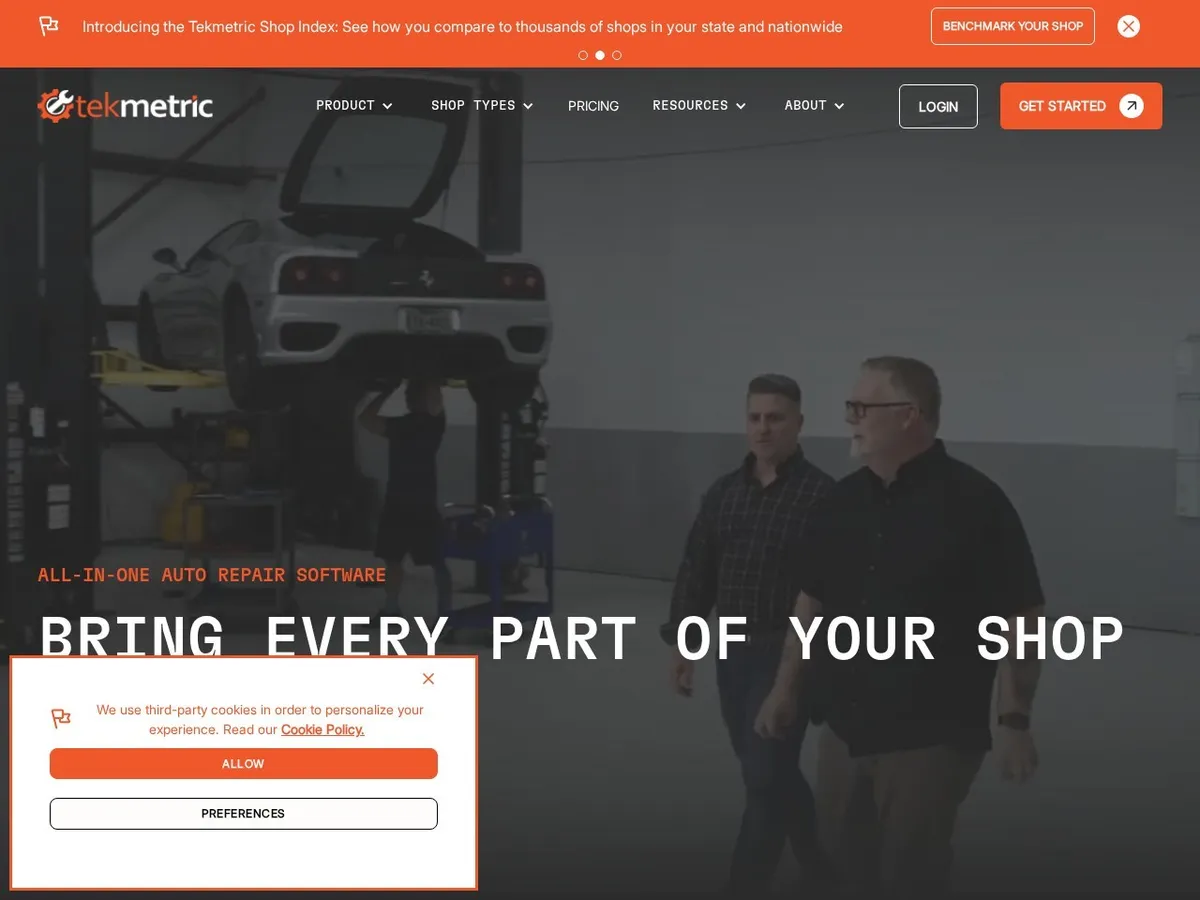
- +
A true end-to-end shop management system: work orders, customer communication, invoicing, payment processing and multi-site reporting all in one platform. Designed by Sunil Patel, a former shop owner who understands the business.
- +
Month-to-month billing with no long-term contract, so you can scale up or down with your shops. Strong reputation on G2 (4.9/5 with 487 reviews) and Capterra (4.8/5), the most reviewed in this comparison.
- +
Best-in-class for multi-site chains: unified parts pricing, labor matrices and consolidated reporting across locations. Extensive API and 70+ integrations, from payment gateways to inventory partners.
- –
Plans beyond the Start tier (Grow and Scale) climb quickly in price, especially with add-ons like Multi-Shop and Tire Suite. Annual prepayment is cheaper but less flexible.
- –
A few reviews note a learning curve on the initial setup and onboarding; dedicated implementation support is available but may add cost.
Our verdict
Tekmetric is the most complete end-to-end system here: work orders, customer communication, invoicing, payment processing and multi-site reporting in one place, billed month to month with no long-term contract. Prices climb fast above the Start tier once Multi-Shop or Tire Suite are added, and several shops mention a real learning curve during setup.

Shopmonkey
The most intuitive interface for work orders and customer payments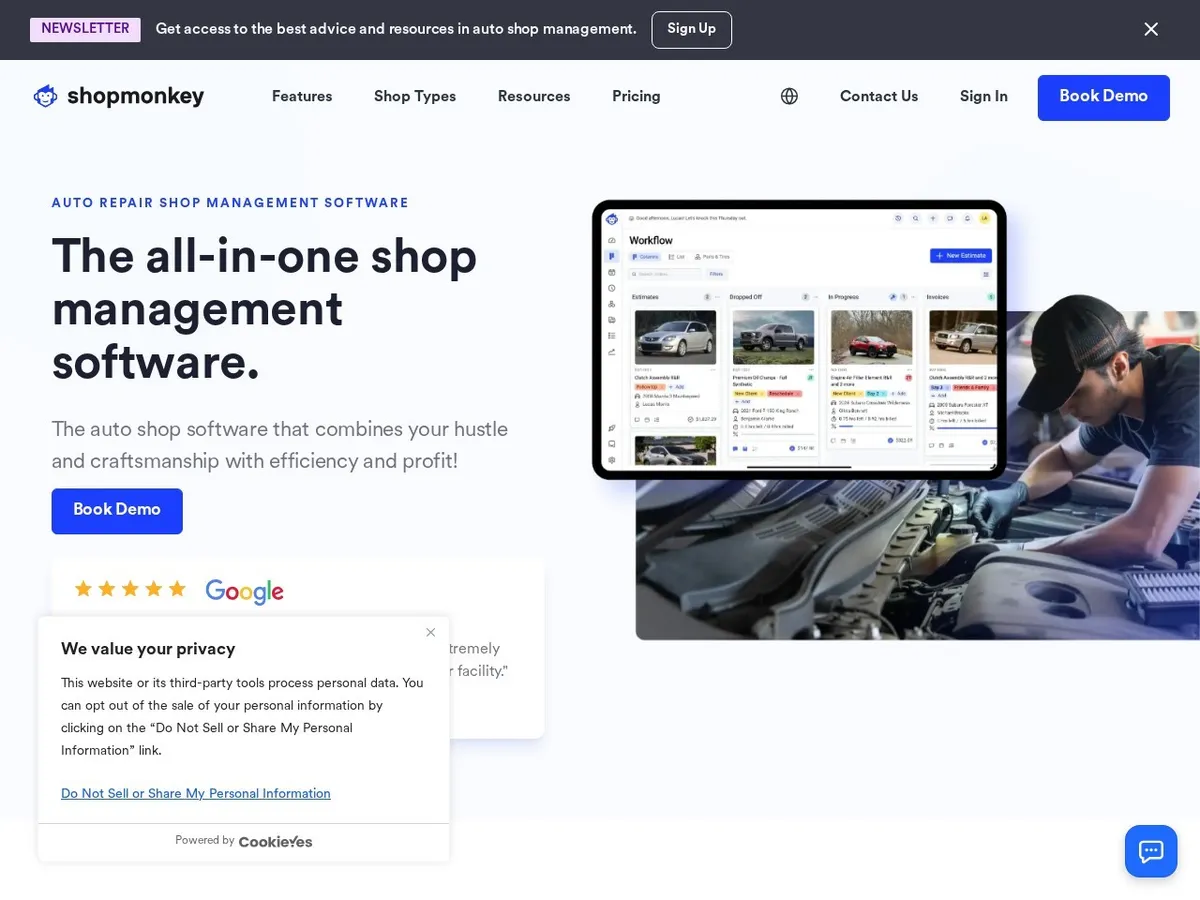
- +
The most polished, no-code interface in the market: work orders, customer messaging and built-in card and ACH payments in a few clicks. Ranked highest for design and ease of use across reviews.
- +
Strong app ecosystem and mobile experience; new features arrive frequently based on community feedback. Customer support is responsive and iterative.
- +
Integrated payment processing simplifies the cash flow for shops that want one platform, one bill.
- –
A major redesign (Shopmonkey 2.0 in 2024) disoriented some long-time users and shifted workflows; migration from older versions requires care.
- –
Coverage for heavy-duty and specialty vehicles is lighter than some competitors. Labor time guides for commercial trucks are less comprehensive.
Our verdict
Shopmonkey has the most polished interface of the six: work orders, customer messaging and card and ACH payments in one no-code flow, with a strong mobile experience and frequent feature drops. The 2.0 redesign disoriented long-time users and complicated migrations, and coverage for heavy-duty and specialty vehicles is lighter than the competition.
Want the smoothest, fastest setup for your shop today?
Tekmetric and Shopmonkey both handle all work order and invoicing needs. Start with the market leader or the most polished interface.

AutoLeap
Highest satisfaction for implementation and support, with QuickBooks built in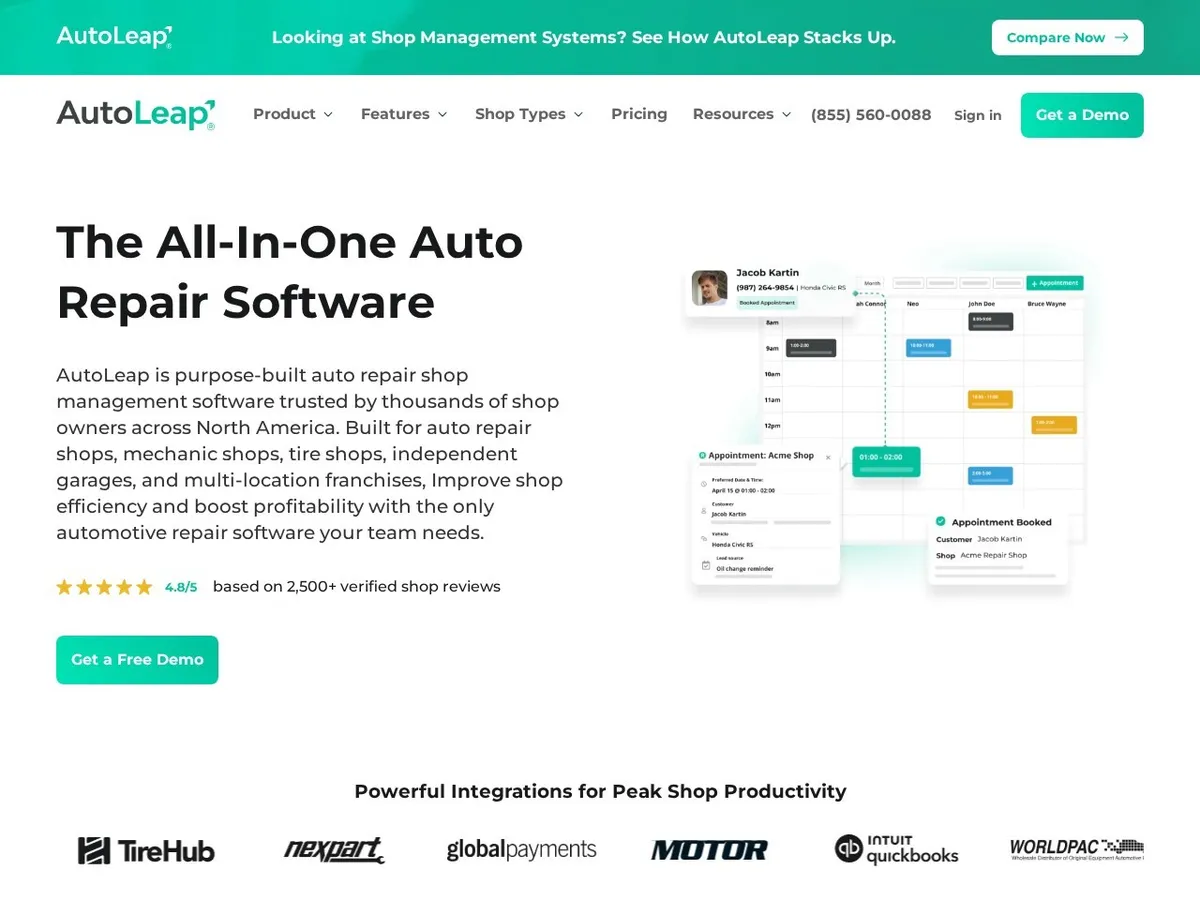
- +
The highest customer satisfaction scores in the market for onboarding and ongoing support. Most shops report feeling confident within their first week, with dedicated implementation help included.
- +
Deep QuickBooks Online integration and direct parts ordering; plus an optional virtual receptionist (AutoLeap AIR) powered by AI to answer calls and schedule appointments outside business hours.
- +
Strong CRM features and marketing tools built in, so shops can track customer history and run promotions without a separate platform.
- –
Annual contracts with 60-day exit windows. Several reviews document friction with auto-renewal and difficulty breaking the contract early; read the terms carefully.
- –
Inspection and parts module workflows are less refined than some competitors; heavy screens and navigation paths are sometimes criticized as cumbersome.
Our verdict
AutoLeap posts the highest satisfaction scores in this market for onboarding and ongoing support, with deep QuickBooks Online integration, direct parts ordering, built-in CRM and an optional AI receptionist. The commercial terms are the weak point: annual contracts with 60-day exit windows, and several reviews describe friction with auto-renewal.

Shop-Ware
Premium UX and customer portal, acquired by Vehlo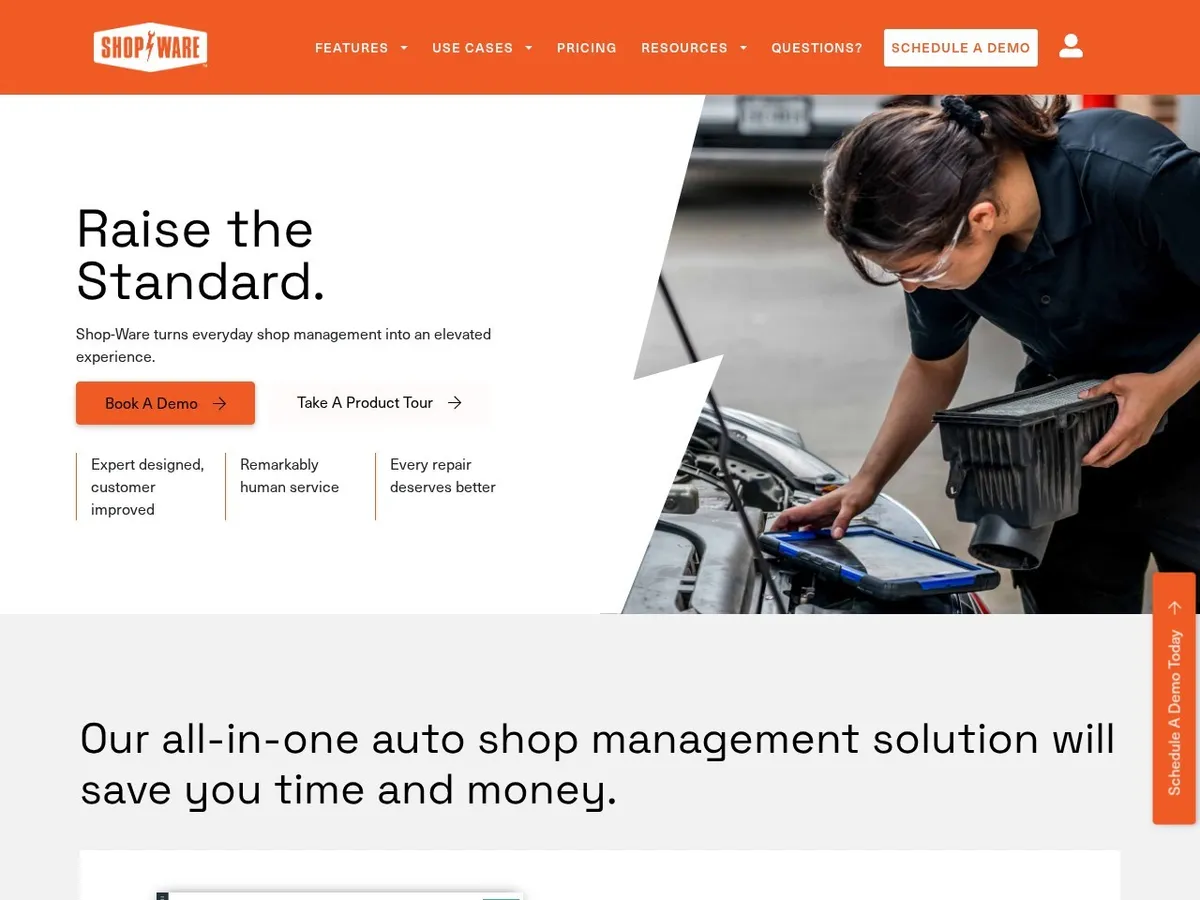
- +
Positioned as a premium solution for shops focused on margin and customer experience. Customer portal and digital vehicle inspection (DVI) workflow are consistently praised as the easiest to navigate in the market.
- +
The platform claims an 89 percent estimate approval rate across customers, higher than the industry average. This translates to more jobs completed and higher revenue per shop.
- +
Since acquisition by Vehlo in March 2024, part of a larger ecosystem; strong technical support and premium build quality.
- –
Pricing is opaque: no public rate card, only on-request quotes after a demo. Makes quick comparison difficult, and implementation can delay your decision.
- –
Payment processor integrations are more restrictive than some competitors; third-party processors may not be supported.
Our verdict
Shop-Ware is the premium option, built around margin and customer experience: its customer portal and digital vehicle inspections are the best presented here, and the platform claims an 89 percent estimate approval rate across its base. Pricing is opaque with quotes only after a demo, and payment processor integrations are more restrictive than elsewhere.
Growing a multi-site operation or selling a premium service?
AutoLeap excels at multi-location support and accounting integration. Shop-Ware is built for shops chasing the highest customer satisfaction and margins.

Mitchell 1 Manager SE
The legacy leader backed by Snap-on, 100+ years of repair data
- +
Unmatched depth in repair procedures and OEM service information: Mitchell 1 owns a century of repair data, integrated with ProDemand platform. VIN-based lookups and service bulletins are more complete than any other option.
- +
180+ pre-built reports and business intelligence; a legacy system trusted by independent shops and chain operators for decades.
- +
Snap-on backing and brand recognition in the industry; parts of the solution have shifted to cloud (OneFlow Estimator, mobile inspections) while maintaining the Windows footprint.
- –
Windows-based heritage with limited mobile-first workflows; the interface is often described as dated (Excel-like) compared to modern cloud competitors.
- –
Pricing is higher than cloud-native competitors for comparable features; newer shops often compare and opt for cloud-based alternatives unless repair data depth is mission-critical.
Our verdict
Mitchell 1 Manager SE brings unmatched depth of repair procedures and OEM service information, a century of data backed by Snap-on, plus 180+ prebuilt reports that legacy shops rely on. It shows its age: Windows heritage with limited mobile-first workflows, an interface often described as dated, and pricing above cloud-native rivals for comparable features.

Shop Boss
Fast setup and ready to use, with unlimited users and work orders included
- +
Designed for shops that want zero learning curve: the system works out of the box, with minimal configuration. Take a live demo and go live the same week.
- +
Unlimited users and unlimited work orders on every plan, a huge advantage for multi-mechanic shops. All plans include digital vehicle inspections and online scheduling.
- +
Customer support and training are well-regarded; the platform integrates with 360 Payments and third-party inventory partners.
- –
Less suited to large multi-site chains: inventory and accounts payable controls are lighter than enterprise-grade platforms.
- –
Some reviews note that parts backordering visibility could be better for high-volume shops tracking multiple vendors.
Our verdict
Shop Boss is the fastest to switch on: it works out of the box with minimal configuration, and every plan includes unlimited users and unlimited work orders, which is a real advantage for a shop with several mechanics. It is less suited to large chains, with lighter inventory and accounts payable controls and limited parts backordering visibility.
Entry price and commitment compared
Three of these six publish a rate card and three do not, and the contract terms matter as much as the monthly figure. Scroll the table horizontally if needed.
| Software | Entry price | Top tier | Commitment |
|---|---|---|---|
| Tekmetric | $199/mo ($179 annual) | $439 Scale | Month to month |
| Shopmonkey | $239/mo ($215 annual) | $499 Genius | Monthly or annual |
| AutoLeap | $199/mo ($179 annual) | $449 Elite | Annual, 60-day exit |
| Shop-Ware | On quote | On quote | On quote |
| Mitchell 1 | On quote | On quote | On quote |
| Shop Boss | $199/mo ($179 annual) | $449 Premier | Monthly or annual |
Key takeaway. At equal entry price, Tekmetric is the only one that combines a public rate card with month-to-month billing. AutoLeap costs the same on paper but locks you into a year, which is the single most common complaint in its reviews.
What each one is actually best at
These six do not compete on the same ground: two are built for scale, two for comfort, one for repair data and one for speed of setup.
| Software | Strong point | Weak point | Best fit |
|---|---|---|---|
| Tekmetric | End-to-end, multi-site | Add-ons raise the bill | Growing shops and chains |
| Shopmonkey | Interface and payments | Heavy-duty coverage | Shops wanting one platform |
| AutoLeap | Support and onboarding | Annual contract | First-time switchers |
| Shop-Ware | Inspections and portal | Opaque pricing | Margin-focused shops |
| Mitchell 1 | OEM repair data | Dated interface | Diagnostics-heavy shops |
| Shop Boss | Unlimited users | Lighter inventory | Multi-mechanic single sites |
Key takeaway. Tekmetric and Shopmonkey are the two safest defaults for an independent shop. Pick Shop-Ware if the customer experience is your differentiator, Mitchell 1 if repair data drives the work, and Shop Boss if you want to be running this week.

How did we build this ranking?
Each tool is scored on five weighted criteria: work order management (end-to-end workflow from intake to invoice), parts and labor (data, time guides, pricing accuracy), ease of use and support (onboarding, learning curve, customer satisfaction), business features (multi-site, reporting, customer communication) and real total cost (base tier, add-ons, multi-shop fees, annual commitment requirements). We favor tools that shops actually use day to day and that help close jobs faster and more profitably. We re-check every pricing and feature change whenever vendors update them, which is why you see an update date at the top of the page.
What should auto repair shop software actually do?
A good shop management system connects four essential workflows that generic accounting software does not address:
Work order intake and routing. A shop receives a car, writes up the work requested by the customer, assigns it to mechanics and tracks parts and labor until the car is done. This generates a road map for the day, not just a list of invoice line items.
Labor and parts data. Pricing must reflect manufacturer-recommended times, warranty labor policies and parts costs from your suppliers. A system that does not have this data built in forces you to guess or manage it manually.
Customer communication and approval. A shop must show customers estimates, progress and a final invoice, and collect payment or approval to proceed. How easy that is to do without friction shapes your approval rate and cash flow.
Multi-site operations and reporting. Shops that run more than one location need unified pricing, consolidated labor metrics and a single dashboard for all locations. This is where most generic tools fall short.
All six of the tools here cover these basics. The difference is how well they do each one and at what price for the full stack.
Cloud versus desktop: which is right for your shop?
Five of the six tools here are cloud-based (Tekmetric, Shopmonkey, AutoLeap, Shop-Ware and Shop Boss), which means you access them from any browser, work orders sync across devices and you do not have to maintain server hardware. Mitchell 1 Manager SE is Windows-based with cloud add-ons for mobile and reporting.
Cloud is now the default for independent shops. It is cheaper to start, easier to scale, and support is faster. The only reason to choose Mitchell 1 is if you need deep OEM repair data that you cannot live without, or if you have already invested heavily in the Mitchell ecosystem.
Watch out for contracts: Tekmetric and Shop Boss are month-to-month. AutoLeap requires annual commitment with a 60-day exit window. Shopmonkey and Shop-Ware lock you in with opaque renewal language; read the fine print carefully before signing.
How much does it really cost to run a shop management system?
The entry tier numbers ($179-$239/month) are just a starting point. A real cost estimate must include:
Multi-site add-ons. Tekmetric charges $70 per additional location per month. AutoLeap builds this in if you run everything under one account, but check your contract. Shop-Ware and Mitchell 1 do not publish per-site fees because they quote you.
Feature add-ons. Tire Suite, Marketing, AI receptionist, these often cost $30-$345 more per month depending on the platform.
Payment processing fees. Card processing is typically 2.9% + $0.30 per transaction, paid on top of your subscription.
Annual vs. monthly. All platforms offer 10-15% off for annual prepayment, but monthly billing is more flexible if cash flow is tight.
For a typical single-location shop with 2 mechanics, budget $250-$350/month with add-ons. For a multi-site chain, that doubles or triples. Start with a free demo and ask each vendor for a detailed quote that includes everything you need for your specific setup.
How do you choose the right shop management system?
Small independent shop that wants to move fast: Shopmonkey and Shop Boss both get you running in days with minimal training. Start with whichever fits your budget.
Multi-site operation or complex workflow: Tekmetric is built for this; its reporting and integrations scale. AutoLeap is a close second if you want the best onboarding experience.
Shops that live and die by OEM data: Mitchell 1 Manager SE is unmatched. Every other tool will require you to supplement its labor data with third-party guides or experience.
Premium shops chasing high margins and customer satisfaction: Shop-Ware is designed for this. The customer portal and inspection workflow are the best in class.
Before you commit, always verify that the system handles your specific vehicle types (heavy-duty, hybrids, specialty), integrates with your parts suppliers and payment processors, and offers a trial or free demo so your team can kick the tires. See our full comparison at MiisterSoftware Invoicing hub for more tools and guides.
Frequently asked questions
What is the best auto repair shop software in 2026?
For most independent shops, Tekmetric is our pick: it covers the full work order lifecycle, integrates deeply with third-party tools, and costs $199 per month with no long-term contract. Shopmonkey offers the most intuitive interface if ease of use is the priority. AutoLeap wins if you want the best onboarding and support, backed by QuickBooks integration. See our full comparison of auto repair shop software for details on all six options.
How much does shop management software cost?
Entry plans start at $199-$239 per month for single-location shops (Tekmetric, AutoLeap, Shop Boss). Multi-site add-ons range from $70-$100 per location per month. Premium features like AI receptionists or tire management are $30-$345 extra. Shop-Ware and Mitchell 1 do not publish pricing; get a demo for a custom quote. Budget $250-$350 per month for a typical small shop with all features included.
Which shop software is best for multi-site operations?
Tekmetric is built for multi-site shops: unified parts pricing, labor matrices, and consolidated reporting across locations are core features. AutoLeap also handles this well with centralized management and strong CRM features. Mitchell 1 Manager SE supports multi-location setups but is more expensive. Avoid Shop Boss if you run many locations; its inventory and AP controls are lighter.
Do I need a trial or free demo before committing?
Yes. Tekmetric, Shopmonkey and Shop Boss all offer online demos and trials. AutoLeap, Shop-Ware and Mitchell 1 require a scheduled demo. A good demo lets your team see the full work order workflow and ask about your specific needs (vehicle types, supplier integrations, payment processing). Never sign without letting your mechanics try it first.
What is the fastest shop software to set up?
Shop Boss is designed to work out of the box with zero configuration: onboarding takes days, not weeks. Shopmonkey is a close second with an intuitive workflow. Tekmetric and AutoLeap require a bit more setup but both include dedicated implementation support. Mitchell 1 and Shop-Ware will require a longer implementation period and are best for shops willing to invest the time.